
Matt Maraldo, PA DEP Certified Radon Technician at ValueGuard Home Inspections in Philadelphia

Our Team · Radon & Environmental Testing

Matt Maraldo

Manager · Certified Radon Technician

A ValueGuard manager and PA DEP Certified radon technician, Matt handles radon, mold, lead, sewer scope and termite (WDI) testing for homes across Southeastern Pennsylvania — Chester, Delaware, Montgomery and Bucks Counties and the City of Philadelphia. Clients describe him as on time, knowledgeable and reassuring.

or call (215) 860-3150

PA DEP
Certified radon technician
5
Testing services
SE PA
Counties & Philadelphia served

I. About

Certified testing, done right.

Matt Maraldo is a manager and Pennsylvania Department of Environmental Protection (PA DEP) Certified radon technician with ValueGuard Home Inspections. He handles the testing services buyers most often add to an inspection — radon testing, mold testing, lead testing, sewer scope inspections and termite (wood-destroying insect) inspections — for homes throughout Southeastern Pennsylvania, including Chester County, Delaware County, Montgomery County, Bucks County and the City of Philadelphia, placing and monitoring professional-grade equipment under the conditions that make each result accurate.

Radon is a colorless, odorless radioactive gas that seeps up from the soil and rock beneath a home — and, according to the EPA and U.S. Surgeon General, it is the leading cause of lung cancer among people who don’t smoke. Because you can’t see or smell it, a proper test is the only way to know your level. That’s where Matt comes in: careful, certified testing and a clear result you can act on. Clients consistently describe him as on time, knowledgeable, friendly and reassuring.

✦ ✦ ✦

II. Why clients trust him

Accurate results, clearly explained.

A radon reading is only as good as the person taking it — the equipment, the placement and the test conditions all matter. Here’s what makes Matt the technician clients count on for a result they can trust.


State-certified
Matt is certified as a radon technician by the Pennsylvania Department of Environmental Protection — the state credential required to measure radon in PA homes.

Protocol-driven testing
Continuous radon monitors placed in the lowest livable level under closed-building conditions for a full test period — the method that produces a reliable, defensible result.

On time, every time
Radon testing runs on the clock — placement and pickup have to be punctual to protect your closing timeline. Clients single out Matt for showing up on time and communicating clearly.

One visit, more answers
Radon, mold, lead, sewer scope and termite (WDI) testing across Chester, Delaware, Montgomery and Bucks Counties and Philadelphia — bundled with your ValueGuard home inspection so you get every answer in one window.

✦ ✦ ✦

III. Services

What Matt tests for.

Matt provides the specialized testing services that go beyond a standard home inspection — each one available on its own or bundled with your ValueGuard inspection in the same visit.


Radon Testing
PA DEP–certified radon measurement using continuous monitors under closed-building conditions — the reliable way to know your home’s level against the EPA’s 4.0 pCi/L action level.

Mold Testing
Air and surface sampling to identify mold and the moisture conditions behind it — important in older homes, basements and any property with a history of water intrusion.

Lead Testing
Testing for lead-based paint and hazards — especially relevant in homes built before 1978, where lead paint is common and matters most for families with young children.

Sewer Scope Inspection
A camera run through the main sewer lateral to reveal cracks, root intrusion, bellies and blockages — catching one of the most expensive hidden repairs before you close.

Termite / WDI Inspection
A wood-destroying insect (WDI) inspection for termites, carpenter ants and other pests — documented on the standard report form lenders and buyers rely on.

✦ ✦ ✦

IV. Credentials

Certification & method.

A ValueGuard manager, Matt is a PA DEP Certified radon technician who tests using continuous radon monitors and follows recognized EPA closed-building measurement protocols.

✓
PA DEP Certified Radon TechnicianPA Dept. of Environmental Protection
✓
Continuous Radon MonitoringProfessional-grade CRM devices
✓
EPA Testing Protocols48-hour closed-building method
✓
MA Music Education & BA Music PerformanceUniversity of the Arts

✦ ✦ ✦

V. Areas served

Philadelphia & SE Pennsylvania.

Philadelphia
Chester County
Delaware County
Montgomery County
Bucks County

Away from the job

A musician on stages worldwide.

Matt is a multi-instrumentalist, composer, performer, producer and teacher. He holds an MA in Music Education and a BA in Music Performance from the University of the Arts, and has performed in more than 15 countries with Grammy-nominated artists.

Today he focuses on producing popular music for new artists and fostering young talent — the same care and precision he brings to every radon test.

✦ ✦ ✦

VI. What clients say about Matt

On time, knowledgeable, reassuring.

ValueGuard has earned 1,300+ five-star reviews across Greater Philadelphia — and clients who test with Matt describe the same experience again and again.
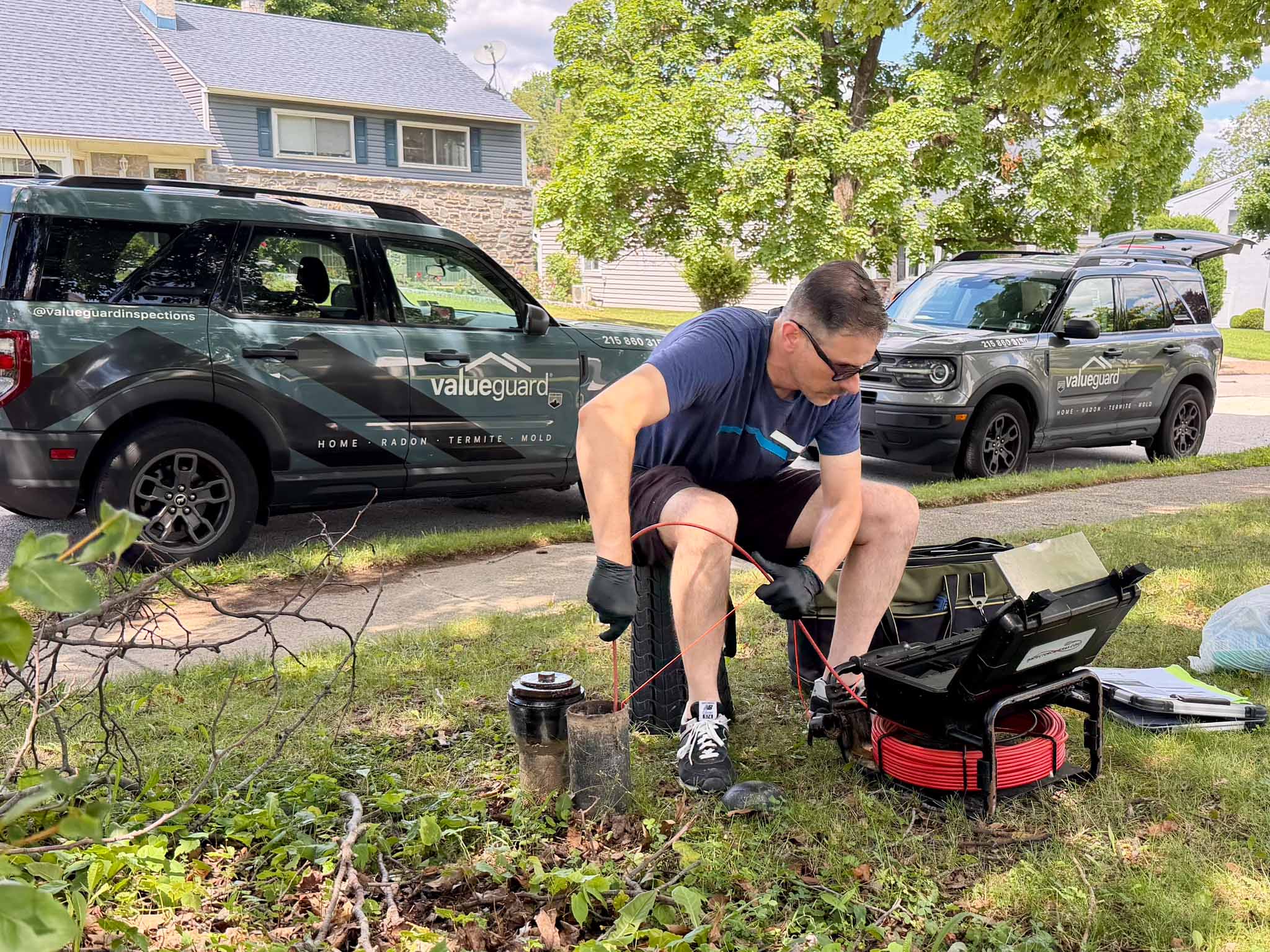
Sewer scope inspection of a Philadelphia home's main sewer line by ValueGuard technician Matt Maraldo

Matt on a recent sewer scope inspection in Philadelphia.

★★★★★

“The radon testing tech was on time and very knowledgeable. Very friendly and assuring.”

B. Williams
West Chester, PA · Google review

★★★★★

“We had Matt over for the sewer line inspection. My house is in Philadelphia. We’ve been impressed with the professionalism he offered. When in need, we are sure ValueGuard will be the name.”

Ho Thuy Anh Nguyen
Philadelphia, PA · Google review

Read all 1,300+ ValueGuard reviews →

✦ ✦ ✦

VII. Common questions

Radon testing, answered.

About Matt

Who is Matt Maraldo?+
Matt Maraldo is a Pennsylvania DEP Certified radon technician with ValueGuard Home Inspections. He conducts radon tests in homes throughout Southeastern Pennsylvania, including Chester, Delaware, Montgomery and Bucks Counties and the City of Philadelphia. Outside of radon work, Matt is an accomplished musician and educator with an MA in Music Education and a BA in Music Performance from the University of the Arts.
Is Matt certified to test for radon?+
Yes. Matt is certified as a radon technician by the Pennsylvania Department of Environmental Protection (PA DEP). Pennsylvania requires anyone who tests, mitigates or sells radon services to be state-certified, so you can be confident your measurement is being handled by a properly credentialed technician.
What areas does Matt serve?+
Matt performs radon testing throughout Southeastern Pennsylvania, including Chester County, Delaware County, Montgomery County, Bucks County and the City of Philadelphia.
Can I request Matt for my radon test?+
Yes. Request Matt by name when you book online or call ValueGuard at (215) 860-3150, and we’ll do our best to schedule your radon test with him based on availability and location.

Radon basics

What is radon?+
Radon is a naturally occurring radioactive gas produced by the breakdown of uranium in soil and rock. It is colorless, odorless and tasteless, so it can’t be detected without a test. Radon moves up from the ground and can accumulate inside homes, especially in lower levels.
Why is radon dangerous?+
According to the U.S. EPA and Surgeon General, radon is the leading cause of lung cancer among people who don’t smoke and the second-leading cause of lung cancer overall. Because exposure builds up over time and has no immediate symptoms, testing is the only way to know whether your home has elevated levels.
How does radon get into a home?+
Radon enters through the points where a home meets the soil — cracks in the foundation floor and walls, construction joints, gaps around pipes, sump pits and crawlspaces. Because indoor air pressure is usually lower than the soil beneath, a home can effectively draw radon gas up and inside.
What radon level is considered too high?+
The EPA sets an action level of 4.0 pCi/L (picocuries per liter): at or above that reading, the EPA recommends installing a radon mitigation system. The EPA also suggests considering mitigation between 2.0 and 4.0 pCi/L, since there is no completely risk-free level of radon.
My home is new / has no basement. Do I still need a radon test?+
Yes. Radon can be elevated in any home — new or old, with a basement, slab or crawlspace. Levels vary house to house even on the same street, so the only way to know your home’s level is to test it directly.

The test

How is a radon test performed?+
Matt places a continuous radon monitor in the lowest livable level of the home and leaves it to sample the air for the test period. The device records radon concentrations over time under controlled conditions, and Matt then retrieves it and calculates the result. Continuous monitors also help confirm the test wasn’t disturbed.
What are “closed-building conditions”?+
For an accurate short-term test, windows and exterior doors should stay closed except for normal entry and exit, beginning at least 12 hours before the test and continuing throughout. This keeps radon from being vented out and lets the monitor capture a representative reading. Matt will explain exactly what to do before the test begins.
How long does a radon test take?+
A standard short-term radon test runs for a minimum of 48 hours. Matt places the monitor, it samples continuously for the test period, and he returns to collect it and generate your result — a timeline that fits neatly inside most real estate inspection windows.
Can radon testing be added to my home inspection?+
Yes. Radon testing is one of the most common add-ons to a ValueGuard home inspection. The monitor is placed at the inspection and picked up after the test period, so you get your home inspection and radon result together as part of one process. Just ask for radon testing when you schedule.
When should I schedule a radon test?+
During a home purchase, schedule radon testing as soon as your offer is accepted so the 48-hour test fits inside your inspection contingency period — often alongside your home inspection. Homeowners can also test anytime; the EPA recommends testing every existing home and re-testing after major renovations or if a mitigation system is installed.

Mold, lead, sewer scope & termite

What other tests does Matt offer besides radon?+
In addition to radon testing, Matt provides mold testing, lead testing, sewer scope inspections and termite / wood-destroying insect (WDI) inspections. Each can be scheduled on its own or bundled with your ValueGuard home inspection so more of your questions are answered in a single visit.
What does a mold test involve?+
A mold test typically uses air and/or surface samples to detect elevated mold and identify the moisture source driving it. It’s worth considering in homes with a musty smell, visible staining, a damp basement or crawlspace, or any history of leaks or water intrusion. Samples are analyzed by a lab and reported with clear results.
When should I get a lead test?+
Lead-based paint was banned for residential use in 1978, so homes built before then are the most likely to contain it. Lead testing is especially important for families with young children or expecting parents, and for any pre-1978 home being renovated. Matt can test for lead-based paint and related hazards as part of your inspection.
What is a sewer scope inspection, and do I need one?+
A sewer scope runs a specialized camera through the home’s main sewer lateral — the line that carries waste to the municipal main or septic system — to check for cracks, root intrusion, bellies, blockages and collapsed sections. Because the sewer lateral is usually the homeowner’s responsibility and repairs can be very costly, a scope is especially wise on older homes and any property with large trees near the line.
What is a WDI (termite) inspection?+
A wood-destroying insect (WDI) inspection checks the home for evidence of termites, carpenter ants, wood-boring beetles and other pests, along with the conditions that attract them. Findings are documented on the standard WDI report form that many lenders require, and it’s a common and inexpensive add-on to a home inspection.

Results & next steps

What happens if my radon level comes back high?+
If your result is at or above 4.0 pCi/L, the EPA recommends installing a radon mitigation system. The most common approach, sub-slab depressurization, uses a vent pipe and fan to draw radon from beneath the foundation and release it safely above the roofline. These systems are proven and typically bring levels well below the action level, with a post-mitigation test to confirm.
Can a radon problem be fixed?+
Yes. Elevated radon is very fixable. A properly designed mitigation system reliably reduces indoor radon, and levels can be re-tested afterward to verify the fix. An elevated reading is a manageable finding — not a reason to walk away from a home — and knowing the number lets you plan for it.
When will I get my radon results?+
Once the test period is complete and Matt collects the monitor, your radon result is calculated and delivered promptly — typically reported with your inspection documentation so you and your agent can act on it right away.
How much does a radon test cost?+
Pricing depends on whether radon testing is bundled with a home inspection or scheduled on its own. For current pricing, see our pricing page or request a quote, and we’ll give you an exact figure before you book.


✦ ✦ ✦

Ready when you are

Schedule your radon test with Matt. Book with ValueGuard.

Certified, protocol-driven radon testing across Philadelphia & Southeastern Pennsylvania — on its own or bundled with your home inspection. Schedule online in minutes, or call (215) 860-3150.

Schedule With Matt

ValueGuard Home Inspections
100 E Penn Square, Suite 400, Philadelphia, PA 19107 · (215) 860-3150
Mon–Fri 8:30am–5:00pm · Sat 9:00am–4:00pm · Radon testing & home inspections throughout Philadelphia, Chester, Delaware, Montgomery & Bucks Counties, PA