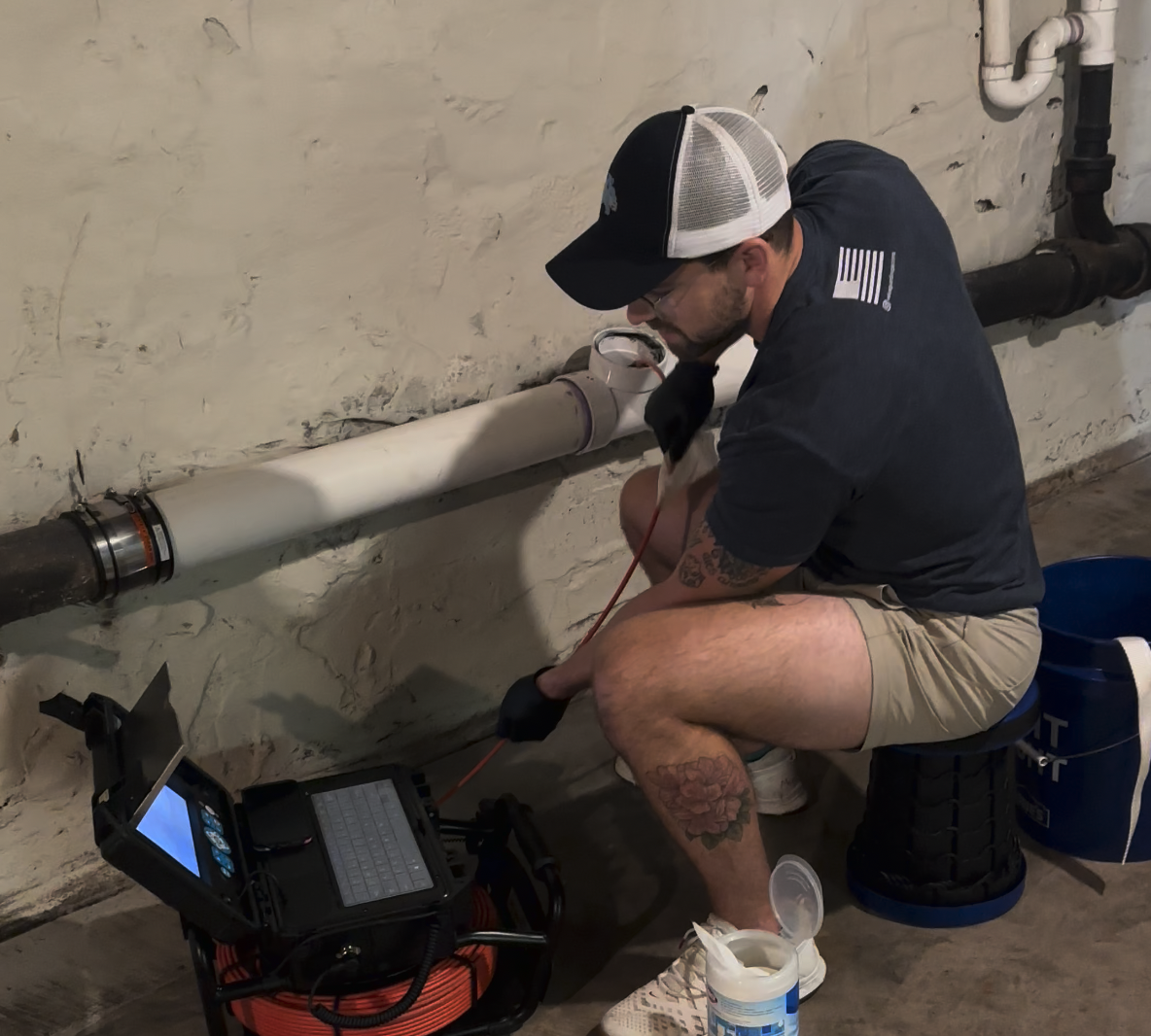
A sewer scope inspection sends a specialized waterproof camera down the home’s sewer lateral — the pipe that carries waste from the house out to the municipal sewer main (or a septic tank). Because that pipe is buried, its condition is invisible during a standard home inspection, yet in Greater Philadelphia’s older housing stock it’s frequently made of clay, cast iron or Orangeburg pipe that’s near — or past — the end of its life. ValueGuard scopes the line from an accessible cleanout, records the whole run, and hands you the video plus a plain-language summary as a convenient add-on to your home inspection or as a standalone visit.
i. Why a sewer scope matters
The most expensive defect you can’t see.
A sewer line problem rarely announces itself before closing — and once you own the home, the buried lateral and its repairs are yours. A scope is a small step that can save a very large surprise; here’s why a sewer scope is critical for Philadelphia homebuyers.
$3,000–$15,000+
Repairs run from a few thousand dollars for a spot fix to well over $15,000 for a full excavated replacement — more when a street or sidewalk has to be opened. Homeowners insurance usually won’t cover it.
It’s your pipe
In Philadelphia, the property owner is responsible for maintaining and repairing the lateral all the way to the city main — and the Water Department can issue a Notice of Defect requiring repair. Many buyers never realize this until it’s too late.
Hidden underground
A standard home inspection covers what’s visible and accessible — the buried lateral isn’t part of it. A camera is the only non-invasive way to see the pipe’s true condition and what it’s made of.
Old Philadelphia pipes
Clay, cast iron and Orangeburg — a 1945–1972 “tar-paper” pipe designed to last only about 50 years — sit under countless older homes here, and mature street trees make root intrusion common.
ii. What we look for
The defects that cost the most.
Traveling the line on camera, your inspector documents the pipe’s material and the problems that turn into backups, sinkholes and five-figure repair bills.
Root Intrusion
The single most common cause of failures. Tree roots find their way into joints and cracks in search of water, then grow until they choke or crush the pipe.
Cracks, Breaks & Collapses
From age, shifting soil, or a failing material like Orangeburg, which absorbs moisture and deforms until sections crack or collapse entirely — a total blockage.
Bellies & Low Spots
Where the pipe has sagged, waste and standing water collect instead of draining away — a “belly” that causes recurring backups and slow drains no snaking will fully cure.
Offsets, Blockages & Corrosion
Joints shifted out of alignment, foreign obstructions and construction debris, plus the scaling and channeling that eat away aging cast-iron lines from the inside.
The buried line
From your house to the city main.
The lateral runs underground from the house, beneath the yard and sidewalk, to the municipal sewer main in the street. Our camera enters at an accessible cleanout and travels the whole run, so we can see exactly where — and what — the trouble is.
2Root intrusion — roots enter at joints and cracks seeking water; the most common cause of blockages.
3Belly / low spot — a sag where waste and water collect instead of draining, causing recurring backups.
4Crack, break or collapse — from age, shifting soil, or failed material such as Orangeburg pipe.
5Offset joint — a section shifted out of alignment that snags debris and leaks at the seam.
6Connection to the city main — in Philadelphia the lateral up to this point is the homeowner’s responsibility.
Illustrative cutaway. A sewer scope reports visible conditions inside accessible lines from the access point toward the municipal connection; it cannot see past a full blockage or collapse, depends on a usable access point, and is not a guarantee against future problems.
iii. Why ValueGuard
Independent sewer scopes you can trust.
Recorded Video You Keep
You get the actual footage of your line plus a plain-language summary of what we found — documentation you can hand to your agent, a plumber or an attorney to price out repairs or negotiate.
The Region’s Most Experienced
ValueGuard has completed 94,000+ inspections across Greater Philadelphia since 1997. We know this region’s housing stock — and the old clay, cast-iron and Orangeburg lines beneath it.
Inspection Only — No Conflict
We scope and report — we don’t sell the repair or the dig, and we don’t steer you to a particular plumber. Our only job is an honest, unbiased look at the line’s true condition.
One Convenient Visit
Add a sewer scope to your home inspection and we handle it in the same visit — no separate appointment, no second day off work, no extra vendor to coordinate during your purchase.
Know the condition of the line before you buy.
iv. The ValueGuard difference
Not all sewer scopes are equal.
A scope is only as useful as the experience reading it and the independence behind it. Here’s how ValueGuard compares.
Fast & Easy
Three simple steps.
A standalone sewer scope starts at $329, and it’s discounted when bundled into an inspection package. Book it on its own or add it to your home inspection — we handle the rest and get you the footage.
Schedule
Book online or call (215) 860-3150. Add a sewer scope to a home inspection, or schedule a standalone visit.
We scope
We feed a camera in at an accessible cleanout and travel the lateral toward the municipal connection, watching for defects the whole way.
Video & report
You get the recorded footage and a clear summary of the findings — ready to share with your agent, a plumber or your attorney.
v. Serving Greater Philadelphia
Sewer scopes, county by county.
From historic Philadelphia row homes with clay laterals to postwar homes on Orangeburg pipe, we scope lines throughout the Greater Philadelphia area and into New Castle County, Delaware.
Bucks County
Chester County
Delaware County
Montgomery County
Berks County
Lancaster County
New Castle County, DE
vi. What clients say
From recent ValueGuard clients.
★★★★★
We had Matt over for the sewer line inspection. My house is in Philadelphia. We have been impressed with the professionalism he offered. When in need, we are sure ValueGuard will be the name.
Ho Thuy Anh Nguyen
Google review
★★★★★
We absolutely cannot say enough good things about our experience with ValueGuard! As first time home buyers, we worked with Tyler for the inspection on the house we are buying, and he was excellent. Arrived on time, was absolutely personable and lovely; and extremely thorough when it came to inspecting the house from top to bottom, inside and out. He was extremely knowledgeable and answered every question we had (sometimes repeating the same thing to us more than once) we were anxious, and he made the process so much better; and he taught us so many things we should know when it comes to being homeowners. We had a beautiful report with photos within less than 24 hours of the inspection. Because it was raining they had to come back to inspect the roof and another inspector, Matt arrived early (working around our schedule) and like Tyler was absolutely lovely. Cannot recommend them enough.
Ilana Waber
Google review
Swipe to see more reviews
Read all 1,300+ Google reviews → · See all our reviews →
vii. Common questions
Sewer scope questions.
What is a sewer scope inspection?+
Isn’t the sewer line covered by a standard home inspection?+
What problems can a sewer scope find?+
Which homes especially need a sewer scope?+
How much does a sewer scope cost?+
What if there’s no accessible cleanout and you can’t perform the scope?+
Do you also do the sewer repairs?+
What if the scope finds a problem?+
Can I add a sewer scope to my home inspection?+
Home Inspections →
Bundle a sewer scope with a full home inspection.
See Pricing →
From $329 — less when bundled in a package.
Get a Quote →
Instant online quote in under two minutes.
Ready when you are
Don’t buy the line unseen. Scope it with ValueGuard.
Join the 94,000+ Greater Philadelphia homeowners who trusted ValueGuard. Schedule online in under 3 minutes — or call (215) 860-3150.
100 E Penn Square, Suite 400, Philadelphia, PA 19107 · (215) 860-3150
Mon–Fri 8:30am–5:00pm · Sat 9:00am–4:00pm · Sewer scope inspections throughout Philadelphia, Bucks, Chester, Delaware, Montgomery, Berks & Lancaster Counties, PA and New Castle County, DE