A termite inspection — formally a wood-destroying insect (WDI) inspection — is a careful visual examination of a home’s accessible areas for evidence of termites and other wood-destroying insects, both active and past. Termites are often called “silent destroyers” because they tunnel through structural wood from the inside out, and an infestation can go unnoticed for years. ValueGuard inspects for the signs that matter and documents everything on the industry-standard NPMA-33 report — the same form lenders accept for FHA, VA and conventional financing — as a convenient add-on to your home inspection or as a standalone visit. And because we also handle termite treatment, a single call can cover everything from inspection through a complimentary, no-obligation treatment plan — no scrambling to line up a separate pest-control company mid-transaction.
i. Why a termite inspection matters
A silent threat to Pennsylvania homes.
The eastern subterranean termite is the most economically important wood-destroying insect in the country and the most common in Pennsylvania. By the time damage is visible, the colony has often been at work for years.
~$5 billion a year
Termites cause an estimated $5 billion in property damage across the U.S. each year, affecting roughly 600,000 homes — and most homeowners insurance policies exclude termite damage entirely, treating it as preventable.
PA’s #1 wood-destroyer
The eastern subterranean termite is responsible for most termite damage in Pennsylvania. Southeastern PA — including the Philadelphia area — sees the highest activity, with swarming season typically running from late winter through spring.
Hidden for years
Termites can slip in through a foundation gap as small as a credit card’s edge and feed inside walls, joists and subflooring out of sight. A trained inspection is the most reliable way to catch evidence early — before it becomes expensive.
Your lender may require it
In higher-risk states like Pennsylvania, VA loans generally require a WDI report, and FHA and conventional lenders often request one too. The accepted document is the NPMA-33 — typically valid for about 90 days before closing.
ii. The wood-destroyers we inspect for
Not just termites. Every wood-destroyer.
A WDI inspection on the NPMA-33 covers four categories of wood-destroying insects — not termites alone. Here’s what your inspector is looking for, and the tell-tale signs of each.
Subterranean Termites
By far the most common and destructive WDI in PA. They nest in soil and travel up to the structure through mud tubes.
✓Pencil-width mud tubes on foundations & piers✓Spring swarmers & discarded wings on sills✓Hollow-sounding or blistered wood
Carpenter Ants
They don’t eat wood — they excavate it for nests, favoring moist or water-damaged framing, and can weaken it over time.
✓Smooth, hollowed-out galleries in wood✓Coarse sawdust-like shavings (frass)✓Activity near leaks, sills & damp areas
Carpenter Bees
Large bees that bore near-perfect round holes into eaves, decks, railings and trim to tunnel and nest inside.
✓Round, dime-sized entry holes in trim✓Yellowish staining below the holes✓Bees hovering around fascia & soffits
Wood-Boring Beetles
Reinfesting beetles whose larvae tunnel through wood for years, leaving small exit holes and powdery residue behind.
✓Tiny round or oval exit holes✓Fine, flour-like frass beneath holes✓Damage in joists, beams & subfloors
Where they get in
How termites enter, and the signs we look for.
Subterranean termites live in the soil and work their way up into the structure — through foundation cracks, around plumbing penetrations, and along any wood that touches the ground. Your inspector checks the foundation, basement or crawlspace, sill plates, attic and exterior for the evidence below.
2Wood-to-soil contact — porch posts, deck framing, steps and siding touching the ground give termites a direct path in.
3Foundation cracks & gaps — entry points around the slab, block joints and plumbing penetrations, some barely visible.
4Swarmers & discarded wings — winged reproductives near windows and light in spring, leaving small piles of shed wings. Termites or flying ants?
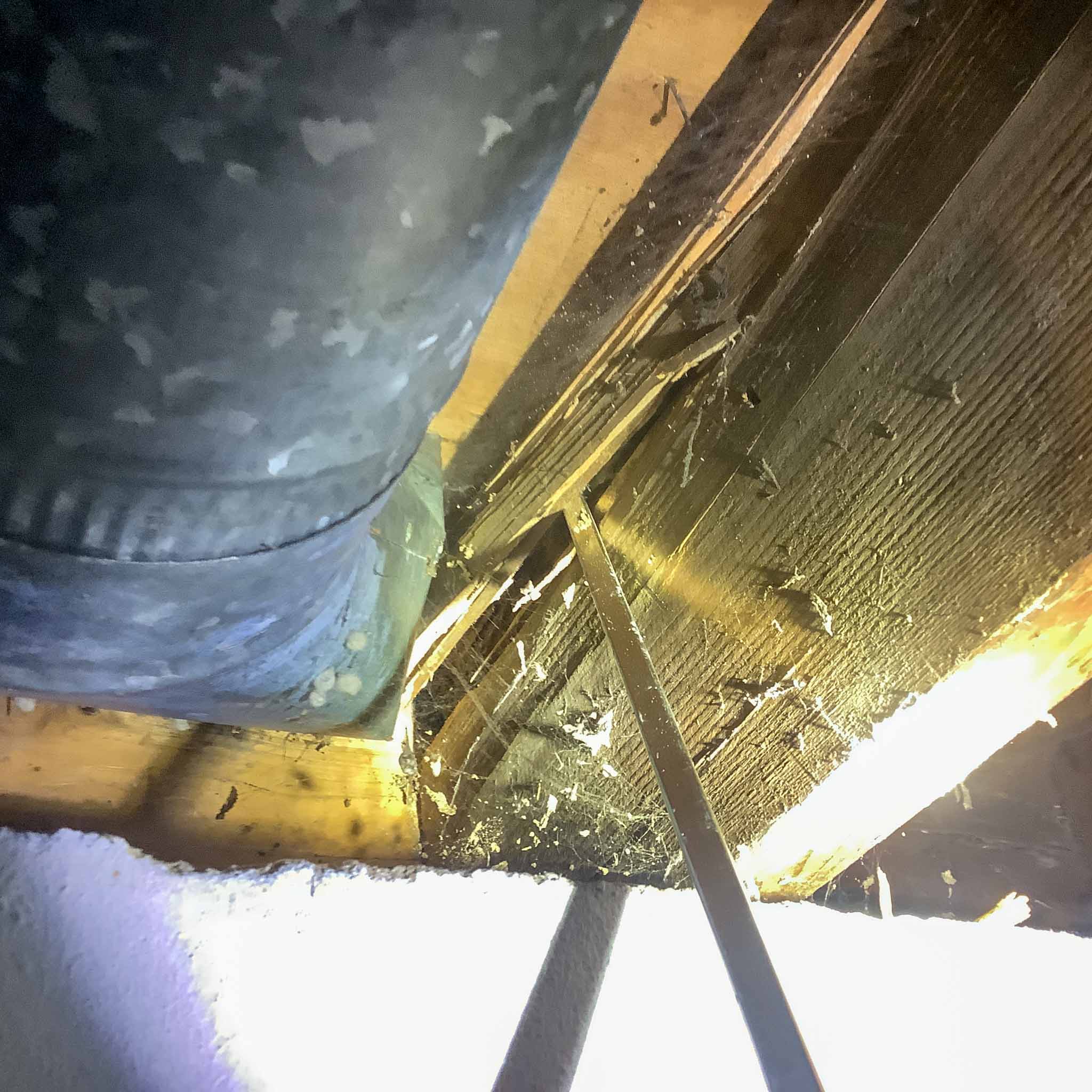
5Damaged & hollow wood — sill plates, joists and framing that sound hollow or probe soft when tapped and sounded.
6Conducive moisture conditions — damp basements, crawlspaces and leaks that make a home far more attractive to termites.
Illustrative cutaway. A WDI inspection reports visible evidence in readily accessible areas; it is not a guarantee against hidden or future infestation, nor a structural-damage report. Concealed areas behind finishes or blocked by stored items cannot be inspected.
iii. Why ValueGuard
Independent termite inspections you can trust.
Licensed WDI Inspectors & the NPMA-33
Your inspection is documented on the NPMA-33 Wood-Destroying Insect Inspection Report — the form FHA, VA and conventional lenders accept — completed and signed by an inspector qualified to do so.
The Region’s Most Experienced
ValueGuard has completed 94,000+ inspections across Greater Philadelphia since 1997. Our inspectors know this region’s housing stock — and the conditions that invite termites — better than anyone.
A Complimentary Treatment Plan
If we find wood-destroying insects, you’ll get a free, no-obligation treatment proposal right away — and our licensed team can carry it out. One company from inspection to resolution, with no scrambling to vet a separate contractor mid-purchase.
One Convenient Visit
Add a termite inspection to your home inspection and we handle it in the same visit — no separate appointment, no second day off work, no coordinating an extra vendor during your purchase.
Buying, selling or financing? Get the WDI report you need.
iv. The ValueGuard difference
Not all termite inspections are equal.
A termite report is only as good as the experience and the independence behind it. Here’s how ValueGuard compares.
Fast & Easy
Three simple steps.
Termite inspections start at $160 — book one on its own or bundle it with your home inspection, and we handle the rest.
Schedule
Book online or call (215) 860-3150. Add a termite inspection to a home inspection, or schedule a standalone WDI inspection.
We inspect
Your inspector examines the accessible areas — foundation, basement or crawlspace, sill plates, attic and exterior — for evidence of wood-destroying insects.
NPMA-33 report
You receive the signed NPMA-33 documenting the findings — ready to hand to your lender, agent or attorney for the transaction.
v. Serving Greater Philadelphia
Termite inspections, county by county.
Southeastern Pennsylvania is among the highest-activity termite regions in the state. We inspect homes throughout the Greater Philadelphia area and into New Castle County, Delaware.
Bucks County
Chester County
Delaware County
Montgomery County
Berks County
Lancaster County
New Castle County, DE
vi. What clients say
From recent ValueGuard clients.
★★★★★
Really nice experience with Michael! Very professional, patient and so humorous. Thorough examination and explanation, and he answered all of our questions and concerns. Will definitely choose them again.
Songlu Li
Google review
★★★★★
This was my first home inspection and I had no clue what it all involved. My inspector Nick explained everything clearly, didn’t rush, and answered all of our questions without hesitation. I highly recommend ValueGuard. Money well spent!
Rahkeeta Rogers
Google · Local Guide
Swipe to see more reviews
Read all 1,300+ Google reviews → · See all our reviews →
vii. Common questions
Termite inspection questions.
What is a termite (WDI) inspection?+
Do I need a termite inspection to buy or finance a home?+
How much does a termite inspection cost?+
What does the inspection cover, and what does the NPMA-33 report say?+
What are the signs of termites in a Pennsylvania home?+
Does ValueGuard also do termite treatment?+
Can I add a termite inspection to my home inspection?+
The report found termites — what happens now?+
Home Inspections →
Bundle a termite inspection with a full home inspection.
See Pricing →
From $160 — standalone or bundled in a package.
Get a Quote →
Instant online quote in under two minutes.
Ready when you are
Don’t let termites go unseen. Inspect with ValueGuard.
Join the 94,000+ Greater Philadelphia homeowners who trusted ValueGuard. Schedule online in under 3 minutes — or call (215) 860-3150.
100 E Penn Square, Suite 400, Philadelphia, PA 19107 · (215) 860-3150
Mon–Fri 8:30am–5:00pm · Sat 9:00am–4:00pm · Termite & WDI inspections throughout Philadelphia, Bucks, Chester, Delaware, Montgomery, Berks & Lancaster Counties, PA and New Castle County, DE