A home inspection tells you the condition of a home today. Smart buyers also want to know what’s coming tomorrow. When was that water heater installed? How many winters does the roof have left? Is the furnace near the end of its run? Those answers are the difference between a confident offer and an expensive surprise eighteen months after closing.
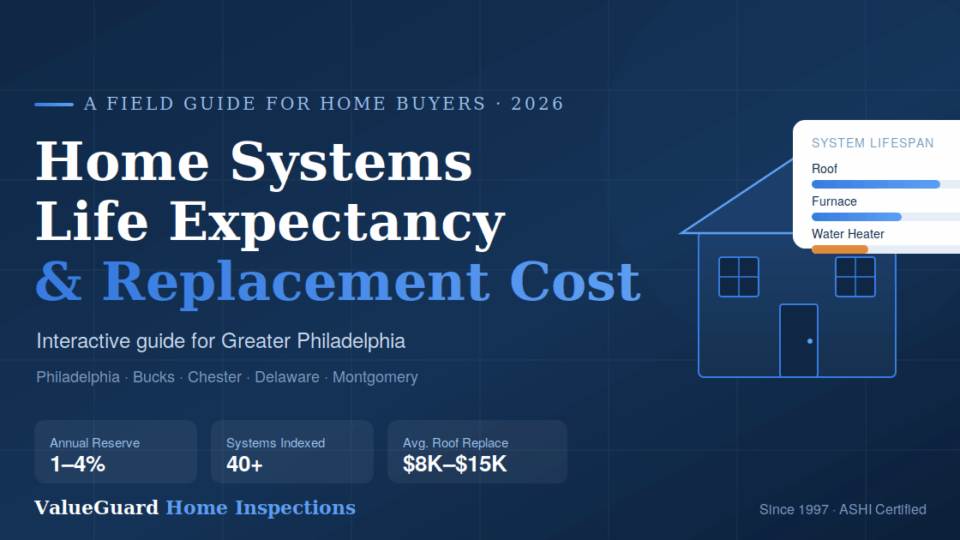
That’s why we built our new, free Home Systems Life Expectancy & Replacement Cost Guide—an interactive field guide for home buyers, 2026 edition. As we put it in the guide itself: a house is not one purchase, it’s dozens of them, scheduled across decades. This tool helps you map out those decades before you sign anything.
Why We Created This Guide
Over 94,000 home inspections across Greater Philadelphia since 1997, we’ve seen the same scenario play out again and again: a buyer falls in love with a home, the inspection goes reasonably well, and then six months later the air conditioner dies in the first heat wave—or the roof starts leaking after a Nor’easter.
None of that has to be a surprise. Greater Philadelphia has some of the oldest housing stock in the country. Rowhomes, twins, Victorians, mid-century colonials, and converted condos all age differently, and the systems inside them have very real, very predictable expiration dates. We built this guide to turn that uncertainty into a plan—and often into negotiating leverage at the closing table.
Four Interactive Tools, One Clear Picture
This isn’t just a static chart. The guide includes four working tools that let you model the real cost of homeownership for the specific house you’re considering.
Annual Reserve Calculator
Enter your home value and condition, and see the recommended annual maintenance budget (1–4% of value) plus the monthly amount to bank toward future replacements.
The Systems Index
A filterable index of lifespans and replacement cost ranges for 40+ home systems—roofing, mechanical, electrical, structural, and more.
Age Analyzer
Pick a system and its install year to see how much useful life it has left. Compare two systems side by side to know what to budget for first.
Replacement Reserve Builder
Check off every aging, deferred, or unknown system and the tool tallies your worst-case replacement exposure into a single dollar range.
A few examples from the Systems Index (for a typical 2,000–3,000 sq ft home):
- Asphalt shingle roof — 20–30 years, roughly $8K–$15K
- Furnace (forced-air) — 15–20 years, roughly $4K–$8K
- Central A/C or heat pump — 10–15 years, roughly $4K–$12K (the most common HVAC replacement during ownership)
- Water heater (tank) — 8–12 years, roughly $1.2K–$2.5K
- Main sewer line replacement — 50–100 years, roughly $6K–$15K
How Greater Philadelphia Home Buyers Can Use It
Before you make an offer. Note the age of the roof, HVAC, and water heater, then run them through the Age Analyzer and Reserve Builder. If multiple big-ticket systems are near the end of their lives, you may have room to adjust your offer or request a credit.
During your inspection. Bring the guide with you. As your ValueGuard inspector documents each system, you’ll have an instant frame of reference for how urgent each finding really is.
After you close. Use the Annual Reserve Calculator to build a real maintenance budget. Knowing the water heater has about three years left means you can set money aside before it leaks into your finished basement.
For homeowners and sellers. Planning to list in Bucks or Delaware County? Knowing which systems are aging helps you decide what to repair, replace, or disclose—and a pre-listing inspection paired with this guide can make your home stand out.
The Cost of Not Knowing
Homes don’t fail all at once. A neglected roof leaks into the joists; saturated joists rot and sag; sagging floors stress drywall, plumbing, and finish work. By the time a homeowner reacts, several systems have quietly been damaged. On top of that, material costs are rising 3–7% per year, insurers increasingly deny claims tied to deferred maintenance, and appraisers penalize aged systems sharply.
Some of the most expensive problems are exactly the ones an untrained eye misses. Anyone can spot a missing shingle. A qualified inspector reads the whole story—checking model numbers against recalls, attic ventilation against roof-deck condition, and grading against the foundation line. That’s how we catch issues common in our region’s housing stock, like polybutylene plumbing, known-hazard Federal Pacific and Zinsco electrical panels, and slow water intrusion behind stucco or in crawlspaces.
The Guide Is a Great Start. An Inspection Tells You Where Your Home Stands.
A life expectancy guide gives you the averages. A professional home inspection tells you exactly where the systems in your specific home actually are—their true age, current condition, and what’s likely coming next.
That’s where ValueGuard comes in. Every ValueGuard inspector is an ASHI member, our reports are photo-rich and delivered the next business day, and they include cost estimates for identified issues—giving you real negotiation leverage, not just a checklist. With more local inspections than any other company in the region, we know exactly how Greater Philadelphia’s housing stock ages.
Don’t Buy a House. Buy Information First.
A professional inspection turns this entire guide into a personalized report on the specific home you’re considering—across Philadelphia, Bucks, Chester, Delaware, and Montgomery Counties.
Frequently Asked Questions
How long does an asphalt shingle roof typically last?
What is the 1% rule for home maintenance?
How long does a furnace last? What about a heat pump?
When should I order a home inspection?
Are these cost estimates accurate for my region?
What’s the most underestimated cost in homeownership?
ValueGuard Home Inspections has served Greater Philadelphia since 1997, completing 94,000+ inspections across Philadelphia, Bucks, Chester, Delaware, and Montgomery Counties. ASHI-certified. Family-owned. Next-business-day reports. All figures in the guide are educational estimates as of 2026 and are not a substitute for a professional inspection.