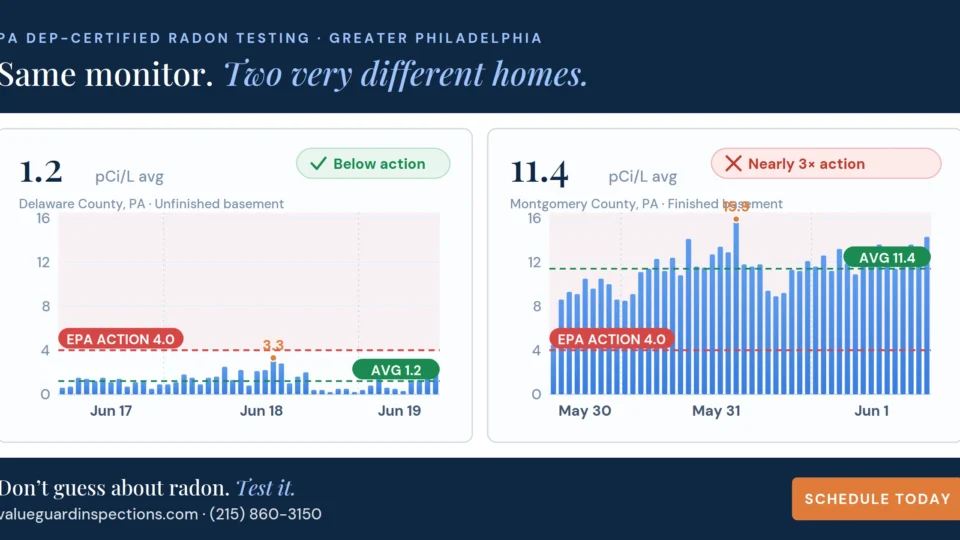
Your radon results land in your inbox as a single number — 1.2, or 4.8, or 11.4 — and a surprising amount rides on it. But that one figure is the end of a story your monitor has been quietly recording, hour by hour, for two full days. Understanding what the number means — and what the hours behind it reveal — is the difference between confidence and guesswork when you’re buying a home in the Greater Philadelphia area.
At ValueGuard, we’ve performed more than 40,000 radon tests across the Philadelphia area since 2012. When a report arrives, most clients ask the same two questions: Is my number safe? And what do I do next? Below, we answer both — using two real ValueGuard tests, run on the same monitor in two different homes, with two very different outcomes.
The short version
Radon is measured in picocuries per liter (pCi/L). The EPA’s action level is 4.0 pCi/L: at or above that, mitigation is recommended; between 2.0 and 4.0, it’s worth considering; and there’s no completely “safe” level. A continuous electronic monitor records a reading every hour for about 48 hours and reports the average. Of the two real homes below, one averaged a reassuring 1.2 pCi/L and the other 11.4 — nearly three times the limit. The figure that matters is your home’s average, and the plan you make if it’s elevated.
What a radon test actually measures
Radon is a colorless, odorless, radioactive gas produced by the natural breakdown of uranium in soil and rock. It seeps into homes through cracks in the foundation and collects in the lowest livable level — and because you can’t see, smell, or taste it, a test is the only way to know it’s there. The U.S. EPA and the Surgeon General identify radon as the second leading cause of lung cancer overall, and the leading cause among people who have never smoked, responsible for an estimated 21,000 deaths in the U.S. each year.
The result is reported in picocuries per liter (pCi/L) — a measure of how much radon is in the air. For perspective, the average indoor level in the U.S. is around 1.3 pCi/L, and outdoor air sits near 0.4. The EPA recommends taking action to reduce radon at 4.0 pCi/L or higher, and to consider action between 2.0 and 4.0. This isn’t an abstract worry in our region: Pennsylvania has one of the most serious radon problems in the country, and roughly 40% of homes tested in PA come back at or above the action level, with eastern Pennsylvania among the highest-risk areas nationally.
| Your radon level | What it means | What the EPA recommends |
|---|---|---|
| Below 2.0 pCi/L | Low — near the U.S. indoor average of about 1.3 | No action required; retest every few years or after major renovations |
| 2.0 to 3.9 pCi/L | Elevated, but below the official action level | Consider mitigation, especially for long-term exposure |
| 4.0 pCi/L and above | At or above the EPA action level | Mitigation recommended — fix the home |
| 10+ pCi/L | Several times the action level | Mitigate promptly |
Two real homes, the same monitor
Numbers on a chart make this concrete. Below are two actual ValueGuard radon tests, run on the same Radalink AirCat continuous monitor, plotted on the same scale so you can compare them directly. (We’ve removed the addresses and owners — only the county and the room are shown.)
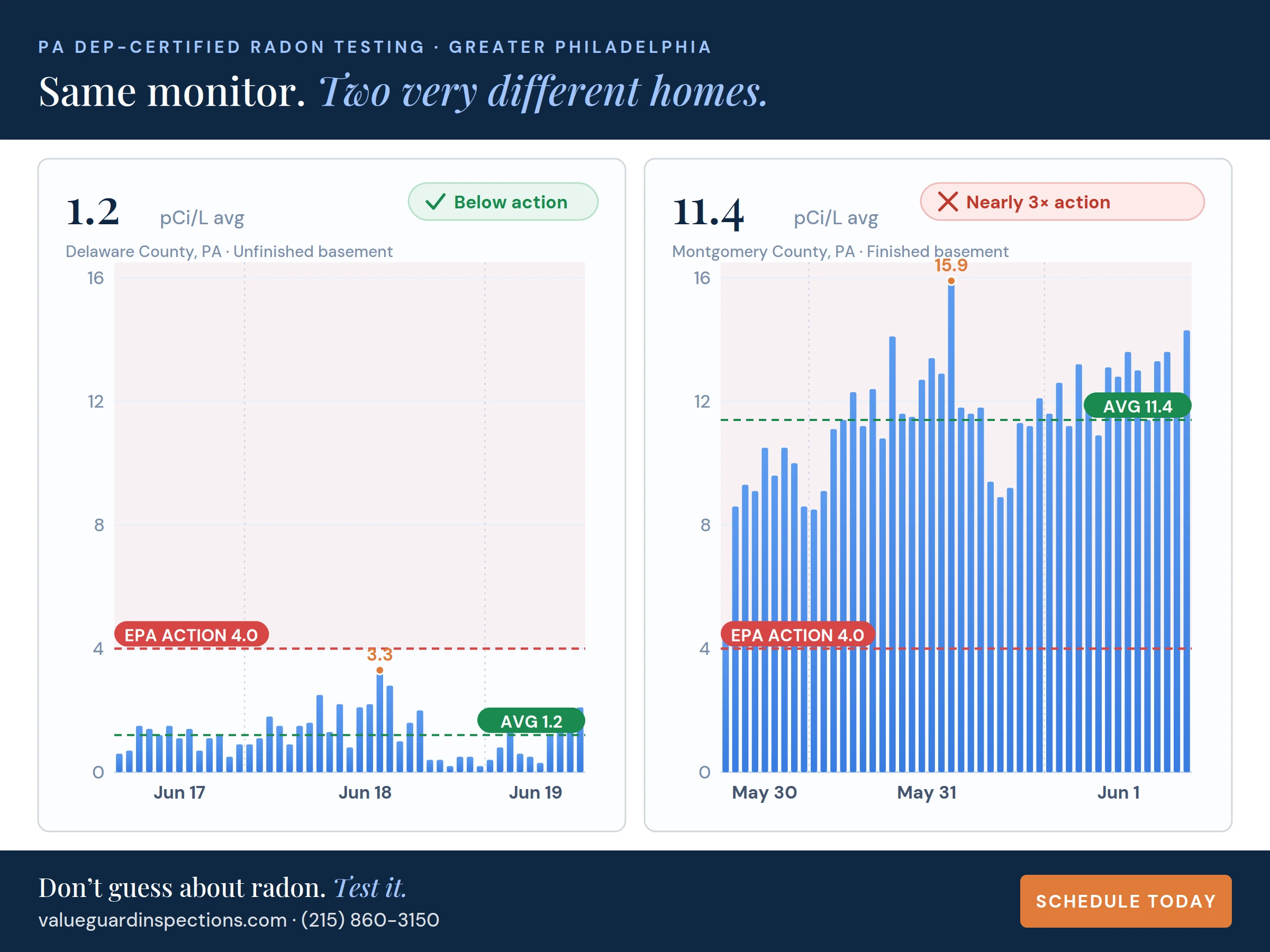
The Delaware County home — an unfinished basement in the Aldan area — averaged 1.2 pCi/L, with hourly readings drifting between 0.2 and 3.3. Every single hour stayed under the action line. The Montgomery County home — a finished basement near Plymouth Meeting — averaged 11.4, with readings ranging from 4.5 up to 15.9. Every single hour was above the limit.
Here’s the part worth sitting with: from the curb, these two homes look the same. Same era of construction, same kind of basement, same monitor, same testing protocol. The only variable is the soil and structure beneath each one — and there was no way to know which home had a problem until it was tested. That’s exactly why the EPA recommends testing every home, regardless of age, style, or what the house next door measured.
Why the hourly readings matter, not just the average
A radon level isn’t a fixed property of a house — it rises and falls with the weather, the time of day, and how the home is being used. A continuous electronic monitor captures that movement by logging a reading every hour for the full test, then averaging the result. A passive charcoal kit, by contrast, gives you a single averaged number with no window into the hours behind it.
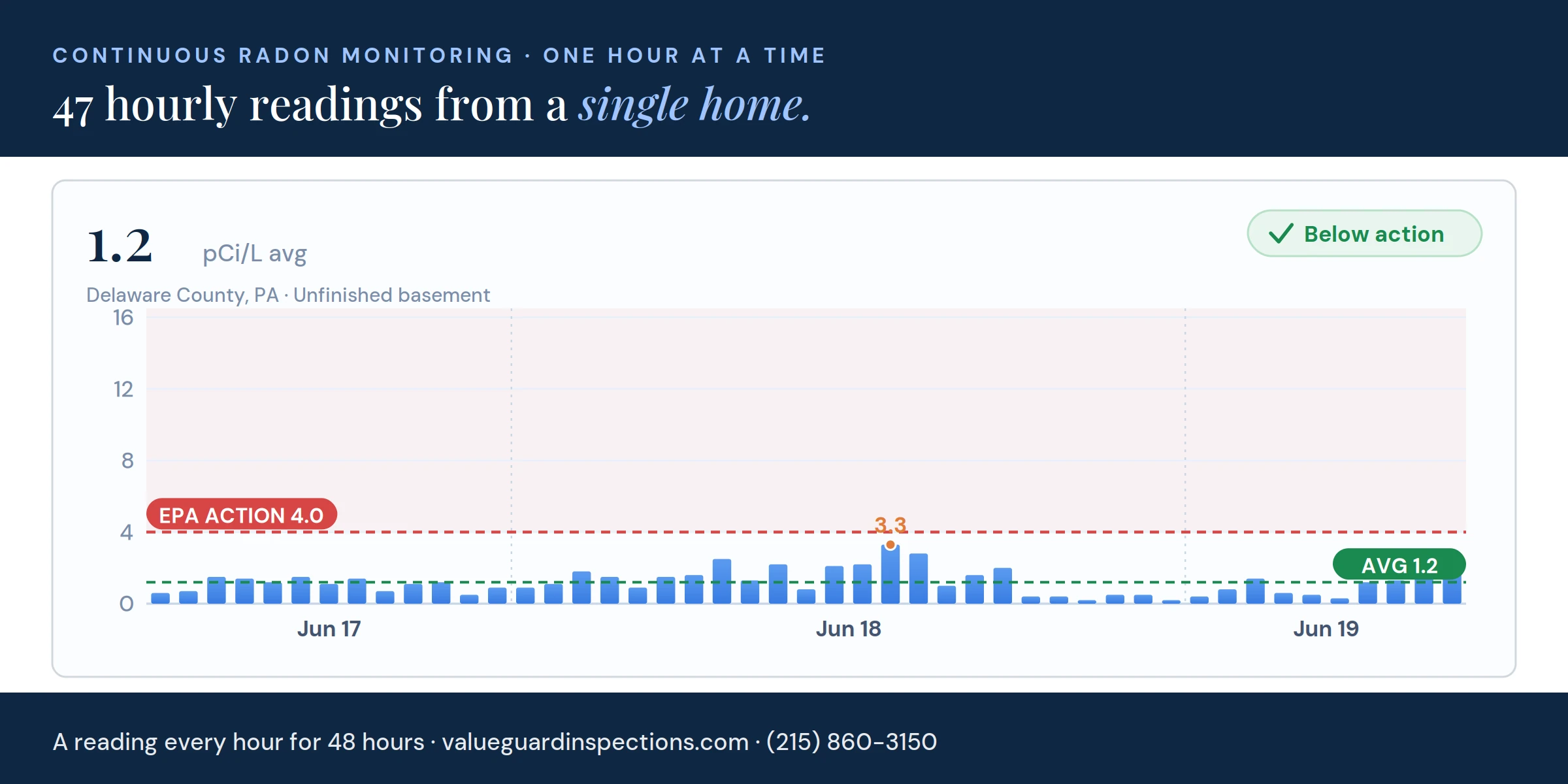
That hourly detail does more than satisfy curiosity. The monitor we use is tamper-resistant: tilt and power sensors flag if the device is moved or unplugged, and it logs temperature, humidity, and barometric pressure so an open window or an unusual weather swing during the test shows up in the data. In a real estate transaction — where a result can affect price and negotiations — that integrity is the whole point. Here’s how a continuous monitor compares to a basic charcoal kit:
| Continuous electronic monitor (ValueGuard) | Passive charcoal kit | |
|---|---|---|
| How it works | An electronic sensor logs radon every hour, on site | Absorbs radon over several days, then mailed to a lab |
| Hourly detail | Yes — a reading for every hour of the test | No — a single averaged number |
| Tamper detection | Tilt, power, temperature, humidity & barometric logging | None |
| Results | Downloaded on site and emailed in about 48 hours | Days to weeks, via a mail-in lab |
| Fits a closing timeline | Yes | Often too slow, and easier to disturb |
So your number is high. What now?
If your average comes back at or above 4.0 pCi/L, like the Montgomery County home above, don’t panic — this is a solved problem. The EPA recommends installing a radon mitigation system, and a professionally installed system can reduce levels by up to 99%. It’s typically a one-time cost in the low thousands of dollars or less — a small price against the long-term health risk of leaving it alone. After the work is done, the EPA recommends a follow-up test to confirm the system is doing its job.
One thing worth understanding about your result: ValueGuard is a testing-only firm. We don’t perform mitigation, and we don’t steer you toward a particular contractor if your levels are elevated. That independence is deliberate — it means our number reflects your home’s true radon level and nothing else, with no incentive to find a problem that isn’t there. If your result is high, the Pennsylvania Department of Environmental Protection maintains a list of certified mitigation professionals, and we’re glad to walk you through what your report means.
A ValueGuard radon test is a short, simple process from start to finish:
1 Schedule your test
Book online or by phone. You can add radon to a full home inspection — the most convenient option during a purchase — or schedule a standalone test for a home you already own.
2 The 48-hour test
A PA DEP-certified technician places a tamper-resistant continuous monitor in your home’s lowest livable level. For the most reliable reading, windows and exterior doors should stay closed as much as possible during the test — what’s called closed-house conditions.
3 Your results — and a clear next step
At the end of the test, your technician downloads the data on site in minutes and emails you accurate, dependable results — no waiting on a mail-in lab. If your level is fine, you have peace of mind. If it’s elevated, you have an unbiased number and a clear path forward, with no upsell attached.
If you’re buying, get the radon test done inside your inspection window. A result at or above 4.0 pCi/L is a legitimate negotiating point: you can ask the seller to install — and pay for — a mitigation system before closing, or to credit you for it. Wait until after closing, and that bill becomes yours.
Reading your results: what to check
- What’s the average? Compare your home’s number to the 4.0 pCi/L action level — that’s the figure that drives the decision.
- Was it a 48-hour continuous test? A monitored, hourly test is more reliable and tamper-resistant than a basic charcoal kit.
- Where was the monitor placed? It should sit in the lowest livable level, where radon collects.
- Were closed-house conditions kept? Open windows during the test can skew a result low.
- If it’s elevated, what’s the plan? Budget for a mitigation system and a post-mitigation retest to confirm it worked.
One number, real peace of mind
Two homes, the same monitor, two very different stories — and only a test could tell them apart. Whether your result comes back like the Delaware County home or the one in Montgomery County, the value is the same: you replace a hidden unknown with a clear fact and a manageable plan. Our job at ValueGuard is to give you that fact you can trust, and the context to act on it.
Whether you’re buying in Philadelphia itself or in the surrounding suburbs of Montgomery, Bucks, Chester, and Delaware County, find out your home’s number before you buy. Ready for clarity? Schedule your ValueGuard radon test today.
Frequently asked questions about radon results
What is a safe radon level?
There’s no completely safe level of radon, but the EPA’s action level is 4.0 pCi/L. At or above that, mitigation is recommended; between 2.0 and 4.0, it’s worth considering. The average indoor level in the U.S. is around 1.3 pCi/L, so a result below 2.0 is generally considered low.
What does pCi/L mean?
It stands for picocuries per liter, the standard unit for measuring radon concentration in air. The higher the pCi/L number, the more radon is present. Your test result and the EPA’s 4.0 action level are both expressed in pCi/L.
My result is below 4.0 — am I fine?
A result below the 4.0 action level is reassuring, and below 2.0 is considered low. Because there’s no completely safe level, the EPA notes that reducing radon can lower risk even between 2.0 and 4.0. It’s also good practice to retest every few years or after major renovations, since levels can change.
My result is above 4.0 — what do I do?
The EPA recommends installing a radon mitigation system, which can reduce levels by up to 99% and is typically a one-time cost in the low thousands of dollars or less. After installation, a follow-up test confirms it’s working. If you’re buying, an elevated result is a fair point to negotiate with the seller before closing.
Why does a continuous monitor matter versus a charcoal kit?
A continuous electronic monitor records a reading every hour and is tamper-resistant — it logs tilt, power, temperature, humidity, and barometric pressure, so a disturbed test shows up in the data. A passive charcoal kit gives only a single averaged number, mailed to a lab, with no way to verify the conditions during the test.
How long does a radon test take, and when do I get results?
The monitor runs for about 48 hours. At the end, the technician downloads the data on site in minutes and emails you the results — no waiting on a mail-in lab.
How common is high radon in the Philadelphia area?
Very common. Pennsylvania has one of the most serious radon problems in the country — roughly 40% of homes tested come back at or above the 4.0 action level, and eastern Pennsylvania is among the highest-risk regions nationally. Elevated radon can occur in any home, regardless of age or whether a neighbor tested low.
Does ValueGuard also do radon mitigation?
No — and that’s intentional. ValueGuard is a testing-only firm. We don’t perform mitigation or recommend a specific contractor if results are elevated. Keeping testing and mitigation separate removes any conflict of interest, so your result reflects your home’s true radon level.
Can I add radon testing to my home inspection?
Yes. Radon testing is one of our most popular add-ons and is the most convenient option during a real estate transaction. You can also schedule a standalone radon test for a home you already own.

About ValueGuard Inspections. ValueGuard Inspections is a PA DEP-certified, testing-only radon firm that has completed more than 40,000 radon tests across the Greater Philadelphia area — Philadelphia, Montgomery, Bucks, Chester, and Delaware counties — using tamper-resistant continuous monitors with accurate results in 48 hours. Radon testing pairs naturally with a full home inspection.
Enjoying our home inspection guides? Get ValueGuard articles in your Google results: