
The short version
Keep your home’s indoor relative humidity below 60% — ideally between 30% and 50%. That’s the range the EPA points to, and it’s the sweet spot that discourages mold, dust mites, and the slow moisture damage that eats away at wood, drywall, and insulation.
When indoor humidity runs high for weeks or months, three things tend to follow: mold and allergen growth, aggravated asthma and allergies, and damage to the structure and your belongings. A $15 hygrometer tells you where you stand; a home inspection tells you where the moisture is coming from.
Humidity is one of those things you feel long before you measure it — the sticky bedroom that won’t cool down, the musty smell in the basement, the bathroom mirror that stays fogged for an hour. In the Greater Philadelphia area, where humid summers meet a lot of older housing stock, indoor moisture is one of the most common issues we flag on an inspection. The good news is that it’s also one of the most manageable, once you know the number you’re aiming for.
Relative humidity, or RH, is simply how much moisture the air is holding compared to how much it could hold at that temperature. Authoritative sources — the U.S. Environmental Protection Agency (EPA), the Centers for Disease Control and Prevention (CDC), the Mayo Clinic, and decades of peer-reviewed research — converge on the same target for a healthy home. It’s the same range we reference in MoistureGuard, the moisture assessment built into our inspection reports. Here’s what happens when you drift above it, and how to bring it back down.
1The range to aim for — and why it matters
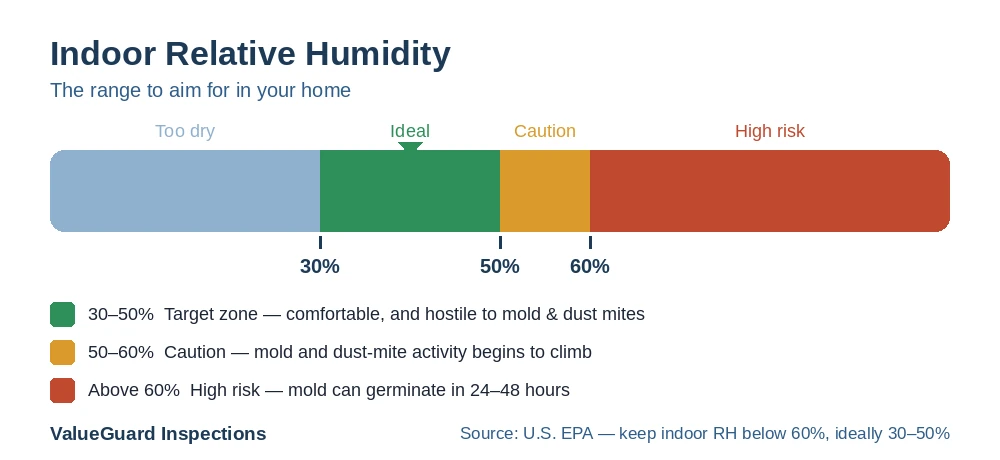
The EPA’s guidance is consistent across its mold and indoor-air materials: keep indoor relative humidity below 60%, and ideally between 30% and 50% — the same range the Mayo Clinic points to for home comfort and health. The CDC echoes the same idea — keep humidity as low as is practical and comfortable. Below about 30% the air gets uncomfortably dry (static shocks, cracked skin, sore throats); above 50–60% you start handing mold and dust mites the moisture they need to thrive. The 30–50% band is where comfort, health, and building durability all line up.
Here’s a quick reference for reading a hygrometer, since a number by itself doesn’t mean much until you know which zone it lands in:
| Indoor RH | What it means | What to do |
|---|---|---|
| Below 30% | Too dry. Static, dry skin, irritated sinuses, gaps opening in wood floors. | Add moisture — a humidifier, common in winter with the heat running. |
| 30% – 50% | The target zone. Comfortable, and hostile to mold and dust mites. | Hold it here. Around 45% is a good single-target setting. |
| 50% – 60% | Caution. Dust mite and mold activity start to climb, especially on cool surfaces. | Run the AC or a dehumidifier; improve ventilation. |
| Above 60% | High risk. Mold can germinate on damp organic surfaces within 24–48 hours. | Act now — dehumidify and track down the moisture source. |
One important nuance: the reading on your hygrometer is the ambient humidity in the middle of the room. Moisture problems often start on cold surfaces — an uninsulated exterior wall, a basement slab, a cold-water pipe — where the local humidity right at the surface can be far higher than the room average. That’s why a house can read a “safe” 50% and still grow mold behind a closet on a north wall. It’s exactly the kind of thing an inspection is built to catch.
2What high humidity does to your health
Mold and the allergens that come with it
Mold spores are always present in household air; what they lack indoors is moisture. Sustained high humidity gives it to them. The EPA notes that mold produces allergens, irritants, and in some cases mycotoxins. Exposure can trigger allergic reactions — sneezing, runny nose, red eyes, skin rash — set off asthma attacks in sensitized people, and irritate the eyes, skin, nose, throat, and lungs even in people who aren’t allergic. Growth often hides where you can’t see it: behind drywall, inside wall cavities, in attics, and in crawl spaces.
Dust mites
Dust mites are a second moisture-driven allergen. They flourish in warm, humid conditions — populations climb well above 50–60% RH and peak higher still. Their waste and body fragments are potent asthma and allergy triggers. The research here is encouraging for homeowners: keeping indoor RH under about 50% reduces dust mite populations and allergen levels over time. One controlled study found that holding humidity below roughly 51% led to a major decline in live mites and the allergens they produce — no pesticides required, just drier air.
Breathing and broader respiratory effects
Humid air can affect breathing directly. A 2012 clinical study found that breathing hot, humid air produced an immediate rise in airway resistance and coughing in people with mild asthma, while healthy participants showed little response — an effect traced to temperature-sensitive sensory nerves in the airways. More broadly, research has linked elevated humidity to reduced lung function, more frequent flare-ups of obstructive lung disease, and higher rates of respiratory infection in some populations. High humidity can also concentrate other airborne allergens and pollutants. Add in the everyday toll — poor sleep, that sticky, fatigued feeling, skin irritation — and the case for staying in range is hard to argue with.
3What it does to the house itself
Health aside, moisture is patient, and it’s expensive. Excess humidity condenses on windows, walls, pipes, and any cold surface, feeding hidden mold and leaving musty odors and staining behind. Left alone, it works its way into the materials your home is built from:
| Component | What chronic moisture does |
|---|---|
| Framing & wood | Absorbs moisture and swells, warps, cups, or splits; prolonged wetness invites fungal decay (wood rot) that can weaken load-bearing members. |
| Drywall | Swells and warps, grows mold behind the surface, and can sag or show its seams as the joint compound breaks down. |
| Metal | Beams, connectors, hinges, and fasteners corrode. |
| Insulation | Loses R-value when it takes on moisture, so the HVAC works harder and energy bills climb. |
| Contents | Furniture, flooring, books, and electronics warp, delaminate, or grow mold. |
In our five-county footprint, the usual suspects are basements and crawl spaces in Philadelphia rowhomes, older stone-foundation houses along the Main Line and across Montgomery and Chester counties, and poorly ventilated attics throughout Bucks and Delaware counties. The material changes but the pattern is the same: a moisture source, a cold or unventilated surface, and time.
4How to monitor it — and how an inspection helps
Monitoring is genuinely easy. A hygrometer — a small humidity gauge that costs somewhere between $10 and $50 at any hardware store — gives you a live reading. Put one in the rooms most prone to moisture (basement, main bathroom, a bedroom) and check them over a few days. If you’re consistently reading above 50–55%, it’s time to act before the number turns into a repair.
A gauge tells you that you have a humidity problem. It won’t tell you why. That’s the gap a home inspection fills. As part of our inspection we run MoistureGuard — a $149 add-on service we include in every ValueGuard inspection package. It measures relative humidity and notes the readings in your report, with any elevated area flagged for follow-up. Alongside the numbers we look for the sources a hygrometer can’t see: grading that sends water toward the foundation, downspouts dumping at the wall, a bath fan venting into the attic instead of outside, a missing crawl-space vapor barrier, condensation lines and duct sweating, and the tell-tale staining and soft spots that mark where moisture has already been at work. Because humidity and radon both ride on the same air paths out of the soil and basement, it often makes sense to pair a moisture assessment with radon testing — one visit, a fuller picture of what the lower level of the house is doing.
⚠ Before you close
A cool, freshly finished basement can read comfortably on move-in day and still hide a chronic moisture problem — new drywall and paint mask stains, and a running dehumidifier flatters the number. If you’re buying, ask when the space was finished, look for a permanent humidity control plan (not a portable unit borrowed for the showing), and have the moisture pathways inspected before the moisture becomes yours to fix.
Bringing humidity back into range
- Measure first. Put a hygrometer in your dampest rooms and watch the trend, not one reading.
- Ventilate the wet rooms. Run bath and kitchen exhaust fans that vent outside, and open windows when the outdoor air is drier.
- Dehumidify the trouble spots. A basement or crawl-space dehumidifier set to hold ~45–50% does most of the heavy lifting in summer.
- Move water away from the house. Clean gutters, extend downspouts, and grade soil to slope away from the foundation.
- Dry spills fast. Materials dried within 24–48 hours of a leak usually won’t grow mold; after that, the odds flip.
Frequently asked questions
What is the ideal indoor humidity level?
Keep indoor relative humidity below 60%, and ideally between 30% and 50%. That range keeps the air comfortable while discouraging mold, dust mites, and moisture damage. Around 45% is a good single target if your dehumidifier or humidistat lets you set one.
At what humidity does mold start to grow?
Risk climbs sharply above 60% RH, where mold can germinate on damp organic surfaces within 24–48 hours. But it isn’t a hard switch — mold can still grow at a “safe” room reading if a cold surface, like an exterior wall or a pipe, stays wet with condensation. Duration and surface contact matter as much as the room’s average.
How do I measure the humidity in my home?
Use a hygrometer — an inexpensive humidity gauge ($10–$50 at hardware stores). Place one in each moisture-prone room and watch the readings over several days rather than trusting a single snapshot.
Is high humidity actually bad for your health?
It can be. High humidity fuels mold and dust mites — both major allergy and asthma triggers — and can irritate the eyes, skin, and airways even in people without allergies. Research also links humid air to worsened asthma symptoms and poorer sleep.
Why is my house so humid even with the AC running?
Common causes include an oversized AC that cools fast without running long enough to dehumidify, bath or dryer vents dumping moist air indoors, a damp basement or crawl space, and water pooling near the foundation. A dedicated dehumidifier plus fixing the moisture source usually solves it where the AC alone can’t.
Can a home inspection detect humidity and moisture problems?
Yes. Our inspection includes MoistureGuard, our moisture assessment, which measures relative humidity and flags any elevated area in your report. Beyond the numbers, we trace the source — grading and drainage, gutters and downspouts, improper venting, missing vapor barriers, condensation, and existing staining, mold, or rot. That’s the difference between knowing you have a moisture problem and knowing what’s causing it.
Is moisture testing included in a ValueGuard inspection?
Yes. MoistureGuard is a $149 add-on service that comes included in every ValueGuard inspection package. It measures relative humidity, notes the readings in your report, and flags any elevated area — with a recommendation for further evaluation, such as a mold or indoor air quality test, when readings run high.
Does high humidity cause structural damage?
Over time, yes. Sustained moisture swells and rots wood framing, warps drywall, corrodes metal connectors, and degrades insulation. If a wood-rot or mold problem is left long enough, it can weaken load-bearing elements — at which point a structural professional should be involved.
Can humidity be too low?
Yes. Below about 30% — common in winter with the heat running — the dry air causes static, dry skin, irritated sinuses, and gaps opening up in hardwood floors and trim. A humidifier brings it back into the 30–50% range.
Do you serve my area?
ValueGuard Inspections serves the Greater Philadelphia area — Philadelphia, Montgomery, Bucks, Chester, and Delaware counties.

About ValueGuard Inspections. We’re a home inspection company serving the five-county Greater Philadelphia area — Philadelphia, Montgomery, Bucks, Chester, and Delaware. Every ValueGuard inspection package includes MoistureGuard, our $149 moisture-assessment add-on, so if your hygrometer keeps reading high or you can smell moisture you can’t find, we can help you locate the source before it becomes a repair. Ask about pairing it with radon testing on the same visit. Learn more at valueguardinspections.com.
Enjoying our home inspection guides? Get ValueGuard articles in your Google results: