
By Matt Maraldo · ValueGuard Inspections
You’re standing in the basement of a beautiful stone colonial, already picturing where the furniture goes. What you can’t see is radon — a colorless, odorless radioactive gas that seeps up from the soil and is a leading cause of lung cancer. Across the Philadelphia region, elevated radon turns up often enough that testing is simply part of doing a home purchase right. But here’s the part most buyers don’t think about: how you test matters just as much as whether you test.
A $15 charcoal kit from a big-box store, a $200 plug-in monitor, and a professional continuous radon monitor are not the same tool doing the same job. They produce different data, hold up differently in a negotiation, and carry very different consequences if they get the number wrong. When your family’s health and your largest financial investment are both on the line, “cheap” can quietly become expensive. So let’s walk through the three ways to test, what each one is actually good for, and which one belongs in a real estate deal.
First, why radon testing matters in our region
Pennsylvania is one of the most radon-affected states in the country, and elevated readings show up regularly throughout the Philadelphia area — including Philadelphia, Montgomery, Bucks, Chester, and Delaware counties. The EPA’s radon-zone map actually rates the immediate five-county area in its moderate and lower tiers rather than its highest one, but here’s the catch the map itself spells out: zone designations don’t tell you about your house. Radon varies street to street and home to home, and individual readings in our area regularly come back at or above the EPA action level even where the map predicts otherwise.
That’s why the EPA recommends every home be tested, regardless of zone — and why a single test on the specific house you’re buying matters far more than any regional average. There is no known safe level of radon, so the goal isn’t to “pass.” It’s to get an accurate number you can act on.
Three ways to test for radon — and they’re not equal
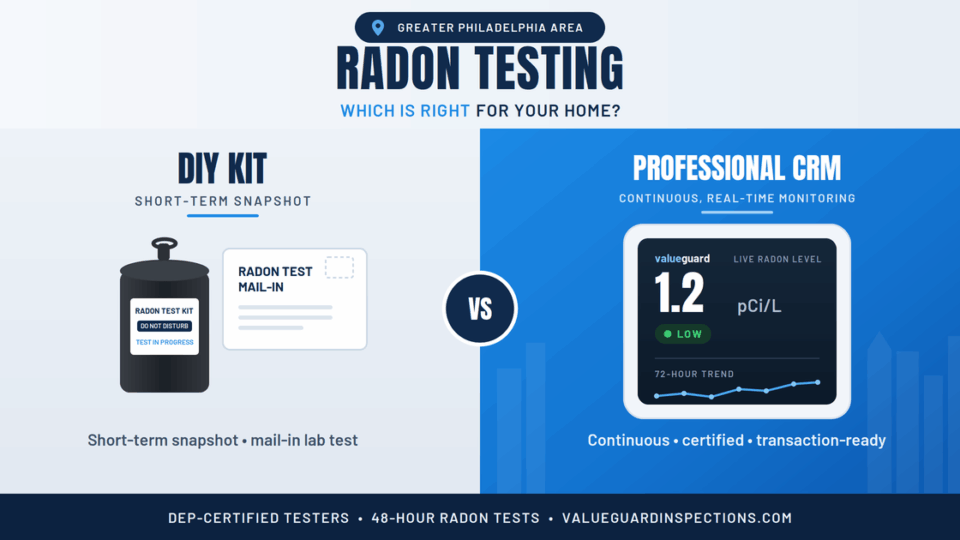
When people talk about radon testing, they tend to lump three very different tools together: a cheap passive kit, a consumer digital monitor, and a professional continuous radon monitor (CRM). Here’s how they stack up before we get into the details.
| DIY Passive Kit | Consumer Digital Monitor | Professional CRM (ValueGuard) | |
|---|---|---|---|
| Typical cost | $10–$60 | $150–$300 | $190 flat |
| How it works | Charcoal or alpha-track media absorbs radon over time, then a lab gives you one average number | Electronic sensor displays ongoing readings on the device or an app | Calibrated active monitor samples the air continuously and logs hourly readings |
| Hourly data & trends | No — one averaged result | Yes, for the homeowner | Yes — full documented hourly log |
| Tamper / condition detection | None | Limited | Yes — motion and environmental sensors flag movement or open-house conditions |
| Calibration to a standard | No guarantee | Varies by model | Yes — regularly lab-calibrated |
| Results turnaround | Days — mail to a lab and wait | Instant on the device | Detailed report shortly after the 48-hour test |
| PA-certified procedure | No | No | Yes — run by a DEP-certified tester |
| Best for | A quick first screen | Long-term awareness in a home you already own | Real estate transactions and negotiations |
| Accepted by agents, lenders & relocation companies | Usually not | Usually not | Yes |
1 The DIY passive kit
Best for a quick, low-stakes first screen.
Charcoal canisters and alpha-track detectors are the budget option, and they have a legitimate use. They don’t actively sample the air — they absorb exposure over a set period and a lab converts it to a single average number. If you already own a home and just want a rough sense of whether radon might be present, a passive kit is a reasonable starting point.
The trouble starts when a passive kit is asked to do more than it can. At $10–$60 it’s cheap, but it’s also fragile and easy to get wrong. Placement matters enormously: set it too close to a drafty window, exterior door, sump, or fan, or leave the home open instead of holding closed-house conditions, and the result can be skewed before you ever seal the package. Then there’s the wait — you mail it, the lab processes it, and in a fast-moving transaction those days can eat straight into your inspection contingency.
And even when everything goes right, you get one number with no context — no hourly log, no way to see whether radon spiked overnight, climbed after a rainstorm, or dropped because a basement door got left open. For a casual screen, fine. For a six-figure decision, a screen is not the same thing as proof.
2 The consumer digital monitor
Best for long-term awareness in a home you already own.
Plug-in monitors from brands like Airthings and EcoSense sit in the middle, usually $150–$300. They’re far more informative than a mail-in kit because they display ongoing readings and let you track radon over time. For a homeowner who wants year-round visibility — especially in a higher-radon pocket of the region — that’s genuinely useful.
But useful does not automatically mean transaction-ready. Independent testing of consumer monitors has found that several units can meet expected accuracy specifications when new and properly functioning — with the important caveat that performance varies by model, environment, exposure period, and calibration. In plain English: good for your own awareness, not built for a high-stakes dispute. If you’re asking a seller for mitigation money before closing, you need data that a buyer’s agent, the seller, a relocation company, and a mitigation contractor will all respect — and that’s where these devices hit their ceiling.
3 The professional continuous radon monitor (CRM)
Best for a real estate transaction — the result that holds up when money is on the table.
A professional CRM is a calibrated active device that stands guard in the home for about 48 hours, sampling the air continuously and recording readings hour by hour. What you’re paying for isn’t just a gadget — it’s calibration, a certified procedure, expert placement in the lowest livable area, chain-of-custody discipline, and a report built to survive scrutiny.
That hourly data is the difference between a number and a narrative. Radon isn’t static — it rises and falls with weather, barometric pressure, HVAC operation, and how tightly the house is closed up. An hourly log lets us see whether levels spiked during a storm or dipped when the system kicked on, which is exactly the kind of detail that becomes negotiation leverage if you need to ask a seller for a mitigation system.
It also closes the door on a real problem: tampering. A passive kit is easy to influence — move it to a porch or crack a window and the reading drops. Many CRMs include motion and environmental sensors that flag movement or violated closed-house conditions, so the result you get is one you can actually trust. At ValueGuard, we test with calibrated RadaLink continuous radon monitors. These are “blind” monitors — neither we nor anyone in the home can see or adjust the readings while the test runs — and the encrypted hourly data is sent to RadaLink’s independent lab, where a radon specialist reviews it and produces the report. It’s an approach built to meet Pennsylvania Department of Environmental Protection (DEP) standards and to give you a result no one can second-guess.
Speed is a feature, not an extra
In a real estate deal, time is the scarce resource. Inspection contingencies are often as short as ten days. Spend three days running a DIY kit and another few waiting on the post office and a lab, and you can burn most of your window before you have an answer. A professional test runs for 48 hours, and because the data is logged digitally and turned around quickly, you receive a clear, detailed report shortly after the test is complete — so you have time to move forward, negotiate, or walk away before your contingency expires.
What “pCi/L” actually means for you
Radon is measured in picocuries per liter (pCi/L). Here’s the context that turns a confusing number into a decision — and a common mistake to avoid: many buyers assume anything under 4.0 is “all clear.” It isn’t quite that simple.
| Radon level (pCi/L) | What it means | EPA guidance |
|---|---|---|
| ~0.4 | Typical outdoor air | Reference baseline |
| ~1.3 | Average U.S. indoor level | No action needed |
| Below 2.0 | Low — though no level is fully risk-free | No action recommended; retest periodically |
| 2.0 – 3.9 | Elevated — above the U.S. average but below the action line | EPA says consider fixing the home |
| 4.0 and above | The EPA action level | EPA recommends you fix the home (mitigate) |
So if a home tests at 3.2 pCi/L, it doesn’t cross the formal EPA action line — but it’s well above the typical U.S. indoor average and still worth a serious conversation, especially in a house where your family will sleep and live for years. Think of pCi/L less as a pass/fail score and more as a risk signal. And the good news on the other side of a high reading: mitigation is relatively affordable and very effective, routinely cutting levels by 80–99% and often bringing a home below 2.0. A professional report is what turns a scary number into a manageable, fixable line item — sometimes a mitigation credit — at the closing table.
Three questions to ask before you choose a radon test
Before you decide how to test the home you’re buying, run through these:
- Is the device calibrated? Professional CRMs are sent to specialized labs for regular calibration. A DIY kit comes with no such guarantee.
- Who is doing the testing? In Pennsylvania, anyone performing radon testing for others must be DEP-certified. Our team is led by Nick Ostrowski, with decades of local experience.
- Will the result hold up at closing? Most buyer’s agents and relocation companies won’t accept a DIY test — they require a professional report from a certified inspector.
A passive kit can tell you radon might be present. A professional CRM test gives you certified data you can stand behind — the difference between “I think this house may have radon” and “here’s the documentation.” When your family’s health and your largest purchase are both at stake, that’s the version worth having.
Frequently asked questions about radon testing
Do I really need a radon test if I’m buying in the Philadelphia area?
Yes. Pennsylvania is one of the most radon-affected states in the country, and elevated readings turn up regularly across Philadelphia, Montgomery, Bucks, Chester, and Delaware counties. Because radon varies house to house, the EPA recommends testing every home regardless of its zone designation — the only way to know your home’s level is to test it.
Is a DIY radon test kit good enough when buying a home?
For a casual first screen of a home you already own, a passive kit is fine. For a purchase, it usually isn’t enough — it gives a single averaged number with no hourly data, is sensitive to placement and handling, can’t detect tampering, and most buyer’s agents and relocation companies won’t accept it in a negotiation.
How long does a professional radon test take?
A radon test runs for 48 hours under closed-house conditions, and you receive a detailed report shortly after the test is complete — well within a standard inspection contingency.
What is a safe radon level?
There is no known completely safe level of radon. The EPA recommends fixing a home at 4.0 pCi/L or higher and considering action between 2.0 and 4.0 pCi/L. For reference, the average U.S. indoor level is about 1.3 pCi/L and outdoor air is around 0.4 pCi/L.
How much does professional radon testing cost?
At ValueGuard, professional radon testing is a flat $190. That covers a calibrated RadaLink continuous radon monitor, a certified testing procedure, expert placement, independent lab analysis, and a documented, transaction-ready report — not just a reading.
What’s the difference between a passive kit, a consumer monitor, and a professional CRM?
A passive kit absorbs radon over time and a lab returns one average number. A consumer digital monitor (such as Airthings or EcoSense) shows ongoing readings for homeowner awareness. A professional continuous radon monitor is a calibrated device that logs hourly data, detects tampering, follows a certified procedure, and produces documentation built for a real estate transaction.
What radon monitors does ValueGuard use?
We test with calibrated RadaLink continuous radon monitors. They record radon along with temperature, humidity, and barometric pressure every hour, and they’re “blind,” meaning the readings can’t be viewed or manipulated during the test. The encrypted data is analyzed by RadaLink’s independent lab, so your results are accurate, tamper-resistant, and unbiased.
Do radon testers in Pennsylvania have to be certified?
Yes. Pennsylvania law has required Department of Environmental Protection (DEP) certification for anyone performing radon testing, mitigation, or lab analysis for others since 1988. A homeowner can test their own home, but a test you intend to use in a transaction should come from a certified professional.
What happens if the radon level comes back high?
A high reading is a manageable, fixable problem. Mitigation systems are relatively affordable and very effective, routinely reducing levels by 80–99% and often bringing a home below 2.0 pCi/L. A professional test report gives you the documentation to request mitigation or a credit before closing.
Which areas does ValueGuard provide radon testing in?
ValueGuard provides professional radon testing across Philadelphia and the surrounding counties — Montgomery, Bucks, Chester, and Delaware.
The bottom line
A DIY kit and a consumer monitor each have their place — a quick screen, or year-round awareness in a home you already own. But buying a house is a different situation, with a tight contingency window and real money on the line. That calls for a calibrated, certified, tamper-aware test that produces a report everyone in the deal will trust. Match the test to the stakes, and you’ll buy with clarity instead of a guess.
Matt Maraldo is a home inspector with ValueGuard Inspections, providing professional home inspections and radon testing across Philadelphia, Montgomery, Bucks, Chester, and Delaware counties.
ValueGuard Inspections provides professional radon testing and thorough home inspections across Philadelphia and the surrounding counties — including Montgomery, Bucks, Chester, and Delaware counties. Ready for a clear, certified answer on the home you’re buying? Schedule your professional radon test today.
Enjoying our home inspection guides? Get ValueGuard articles in your Google results: