
The Short Version
Two little devices with confusingly similar names quietly protect your home from the two worst things electricity can do: shock a person and start a fire. Here’s the whole guide in a nutshell:
- A GFCI protects people from shocks—it belongs anywhere water and electricity meet: bathrooms, kitchens, garages, basements, and outdoors.
- An AFCI protects your home from fires—it guards the wiring inside your walls, in bedrooms, living rooms, and hallways.
- Kitchens and laundry rooms need both—that’s what “dual-function” devices are for.
- Spot them by the TEST/RESET buttons, and press TEST about once a month.
- Missing them in an older home isn’t a code violation—it’s one of the most affordable safety upgrades you can make.
Below: how each one actually works, and exactly where your home needs them.
Somewhere during almost every inspection I do, a buyer points at an outlet or a breaker and asks some version of the same question: “What are those test buttons for, and do I really need them?”
It’s a great question, and it comes up more than almost any other electrical topic. The short answer is that those little buttons belong to two different safety devices—GFCIs and AFCIs—and together they quietly protect your home from the two worst things electricity can do: shock a person and start a fire.
The trouble is that the acronyms sound almost identical, they look nearly the same on the wall, and most homeowners have never had the difference explained without a wiring diagram and a code book. So let’s fix that. No electrician’s license required—just a clear picture of what these devices do, why they matter, and where your home actually needs them.
First, the One-Sentence Version
If you remember nothing else, remember this:
A GFCI protects people from shocks. An AFCI protects property from fires.
Everything else in this guide is detail hanging off those two ideas. GFCI stands for Ground Fault Circuit Interrupter. AFCI stands for Arc Fault Circuit Interrupter. They solve two completely different problems, which is exactly why modern homes need both.
GFCI vs. AFCI at a Glance
GFCI: The Device That Stops a Shock Before It Hurts You
Electricity is supposed to travel in a tidy loop—out to your hair dryer along one wire, back to the panel along another. A ground fault is what happens when some of that current escapes the loop and finds another path to the ground. Very often, that alternate path is a person.
Picture the classic scenario: a hair dryer slips off the counter toward a sink full of water while you’re still holding it. In that instant, electricity wants to rush through the water—and through you—to reach the ground. That’s a ground fault, and it’s how ordinary household current causes serious shocks and electrocutions every year.
Here’s the clever part. A GFCI constantly compares the amount of current flowing out with the amount flowing back. In a healthy circuit, those two numbers match. The moment the GFCI senses even a tiny mismatch—as little as four or five milliamps, a fraction of what it takes to harm you—it knows current is leaking somewhere it shouldn’t. It cuts the power in about one-thirtieth of a second. Faster than you can flinch, the circuit is dead and you’re safe.
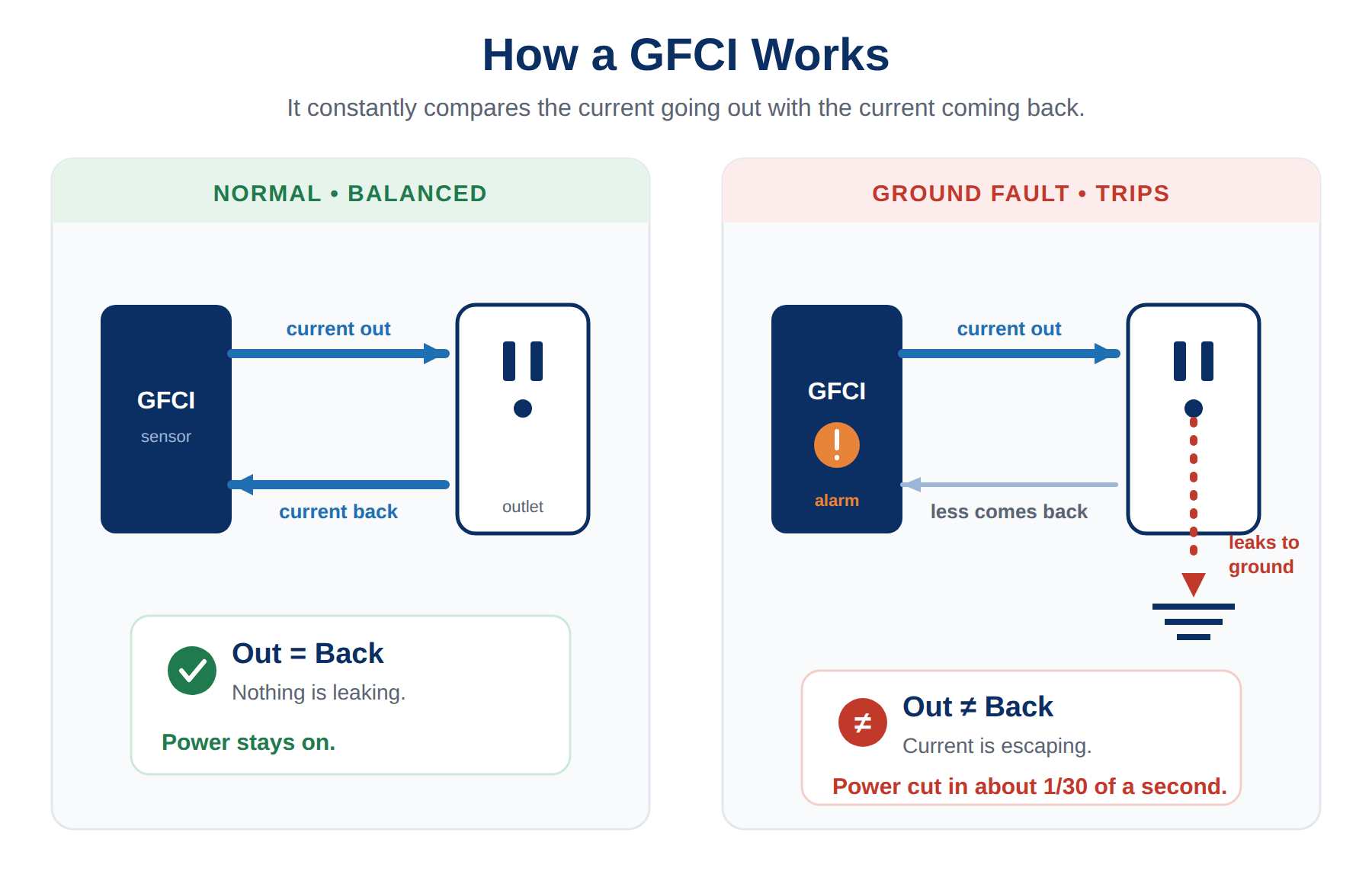
The takeaway: A GFCI is your shock stopper. Wherever an outlet lives near water, this is the device that keeps a spilled drink or a wet hand from becoming an emergency.
AFCI: The Device That Stops a Fire Inside Your Walls
An AFCI is guarding against something you’ll never see coming: a bad electrical arc.
An arc is a spark of electricity jumping across a gap—and some arcs are perfectly normal. Your light switch makes a tiny one every time you flip it. The dangerous kind happens when wiring is damaged: a cable pinched by a carelessly driven drywall screw, a cord crushed under a bed leg for years, a connection that worked itself loose behind an outlet, or insulation gone brittle with age. These faults can arc over and over, throwing off enough heat—thousands of degrees at the point of the spark—to ignite the wood framing, insulation, or dust around them. It’s a fire that starts inside the wall, where no smoke alarm sees it until it’s already spreading.
For decades there was simply no protection against this. A standard breaker only trips when a circuit draws too much current all at once. A small, sputtering arc can burn happily along below that threshold for weeks.
An AFCI is built to recognize the electrical “signature” of a dangerous arc—the erratic, chaotic pattern that damaged wiring produces—and tell it apart from the harmless arc of a vacuum motor or a light switch. When it detects the bad kind, it shuts the circuit down before the heat can start a fire.
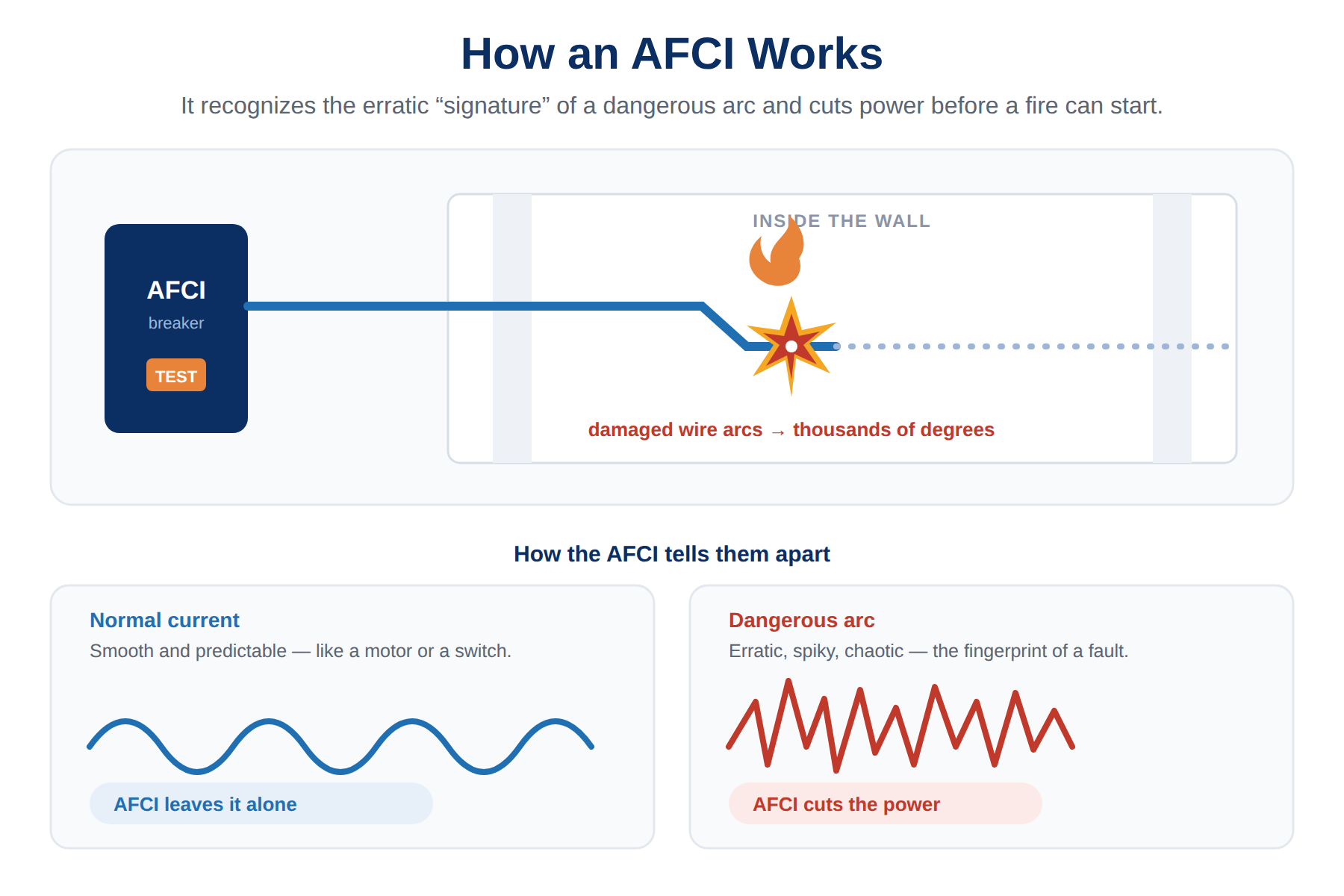
The takeaway: An AFCI is your fire stopper. It’s watching the wiring you can’t see, in the rooms where your family sleeps—which is exactly why it earns its place in bedrooms, living rooms, and hallways.
So Why Not Just One Device?
Because they watch for different dangers and can’t cover for each other.
A GFCI is looking outward—for current escaping the circuit toward a person or the ground. It has no idea whether the wire feeding it is quietly arcing inside the wall. An AFCI is looking inward—for the telltale chaos of a failing connection. It won’t necessarily save you from a shock at a wet outlet. One protects people from shock; the other protects the building from fire. Ask either one to do both jobs and you’ve left a gap.
That’s also why manufacturers now make a dual-function device that combines both in one outlet or one breaker. In a modern kitchen or laundry room—where you’ve got both water nearby and living-space wiring—dual-function protection covers both risks at once.
Where Your Home Needs Each One
This is the part buyers most want a straight answer on. The exact list has grown with every update to the electrical code, but the logic behind it is easy to follow: GFCIs go where water is, and AFCIs go where people live.
GFCI protection is generally called for in the wet and damp zones, including bathrooms, kitchens (countertop outlets and, increasingly, the large appliances too), garages, unfinished basements, crawlspaces, laundry areas, outdoor outlets, and anywhere within about six feet of a sink. Pools, hot tubs, and their equipment are covered as well.
AFCI protection is generally called for across the living spaces, including bedrooms, living rooms, family and dining rooms, hallways, closets, sunrooms, and similar rooms—effectively most of the everyday circuits in a modern home. Kitchens and laundry areas typically call for both forms of protection, which is where those dual-function devices earn their keep.
One honest caveat, and it matters especially around here. The requirements depend on when your home was built or last rewired. Codes aren’t retroactive: a 1925 Fishtown rowhouse or a mid-century twin in the suburbs was wired long before these devices existed, and no one is legally forcing you to tear open finished walls to add them. Pennsylvania updates its statewide building code on a cycle—the most recent update took effect in July 2025—and newer editions have steadily pushed this protection into more rooms of the house. So the rule of thumb is simple: the older your home, the less likely it already has full coverage, and the more worth considering an upgrade.
How to Tell What You’ve Already Got
You don’t need to open your electrical panel to start figuring this out.
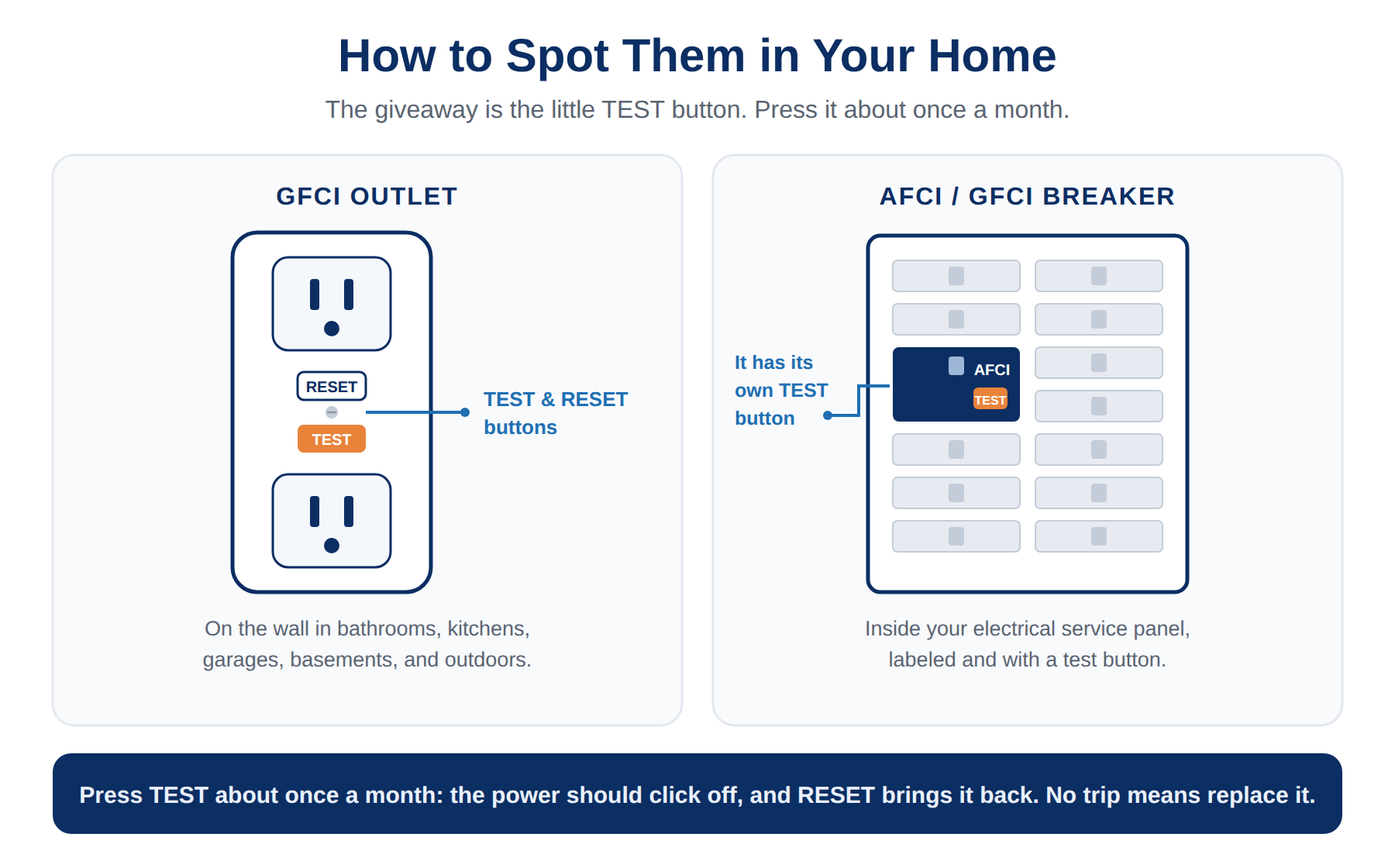
Look at your outlets first. A GFCI (or dual-function) outlet is the one with the small TEST and RESET buttons on its face—the same style you’ve seen in hotel bathrooms. A single GFCI outlet can also protect several ordinary outlets “downstream” of it on the same circuit, so you may have more coverage than the button count suggests.
Then glance at your breaker panel. AFCI and GFCI breakers look like normal breakers but have their own little TEST button right on the switch, usually with a small label. If your panel is a wall of plain breakers with no test buttons anywhere, that’s a strong sign the home predates this protection—useful to know, not a cause for panic.
The habit worth building: press the TEST button on these devices about once a month. It should cut the power with a firm click; pressing RESET restores it. A device that won’t trip when tested, or won’t reset, has failed and should be replaced. These are mechanical safety devices, and like a smoke detector, they’re only protecting you if they still work.
A Quick Word on “Nuisance” Tripping
Every so often a homeowner tells me they’ve got an outlet or breaker that keeps tripping for no reason, and they’re tempted to just replace it with a regular one to make the annoyance stop. Please don’t.
A GFCI or AFCI that trips repeatedly is usually doing its job. It may be catching a genuinely failing appliance, a deteriorating cord, or moisture that’s gotten somewhere it shouldn’t. Occasionally an older AFCI does misread a motor or a specific electronic device, but that’s the exception, not the rule. The right move is to have the cause diagnosed—not to disable the one device standing between a small problem and a serious one. Swapping in a plain outlet doesn’t fix anything; it just removes the alarm.
What This Means at Your Inspection
When we inspect a home, we test the GFCI and AFCI devices we can access and note where protection is present, missing, or not working. On an older Philadelphia home, “no AFCI protection” or “GFCIs missing at the kitchen and baths” is one of the most common things we write up—and it’s a frequent finding on renovated homes too, as we saw in our buyer’s field guide to inspecting a flip, where a clean-looking new panel had no arc-fault protection behind the cover.
It’s important to understand what that finding is and isn’t. In most cases it’s not a code violation the seller is obligated to correct, because the home was legal when it was built. What it is, is a meaningful and very affordable safety upgrade. Adding GFCI outlets in the wet areas or swapping in AFCI/dual-function breakers is inexpensive, non-disruptive work for a licensed electrician—one of the highest-value safety improvements you can make to an older home. Our job is to hand you that information in plain English so you can decide with clear eyes, whether that’s negotiating with the seller or simply putting it on your first-year to-do list.
The finish on a house changes every few years. The wiring behind the walls often doesn’t. These two small devices are how a century-old home gets to keep its character and meet a modern standard of safety—and knowing the difference between them is the first step to making sure yours are doing their job.
Your GFCI & AFCI Quick Reference
Keep these in your back pocket the next time you’re walking a home—or standing in your own basement:
- GFCI = shock protection. It belongs anywhere water and electricity meet: bathrooms, kitchens, garages, basements, laundry, outdoors, and near sinks.
- AFCI = fire protection. It belongs across the living spaces—bedrooms, living and dining rooms, hallways, and closets—guarding the wiring inside your walls.
- Kitchens and laundry rooms usually need both, which is what dual-function outlets and breakers are for.
- Look for the TEST and RESET buttons on outlets, and the TEST button on breakers, to see what protection you already have.
- Test each device about once a month, just like a smoke detector. If it won’t trip or won’t reset, replace it.
- Never “solve” repeated tripping by swapping in a plain outlet or breaker—have the cause diagnosed instead.
- Missing protection in an older home isn’t a failure—it’s one of the most affordable safety upgrades you can make.
Get the Clarity You Deserve
Buying or maintaining a home should feel like a step forward, not a gamble. When you choose ValueGuard, you’re not just getting a checklist—you’re getting a photo-rich, plain-English roadmap of your home’s systems, delivered by the next business day. Our mission is radical transparency: the clear, honest information you need to protect your family and negotiate with confidence.
Ready for peace of mind? Schedule your inspection with ValueGuard today.

ABOUT VALUEGUARD INSPECTIONS
ValueGuard Inspections provides home inspections, sewer scopes, radon testing, and moisture evaluations across Philadelphia, Montgomery, Bucks, Chester, and Delaware counties. Rated 4.9★ by homebuyers — read our reviews on Google. Ready for peace of mind? Schedule your inspection at valueguardinspections.com or call (215) 860-3150.
Enjoying our home inspection guides? Get ValueGuard articles in your Google results: