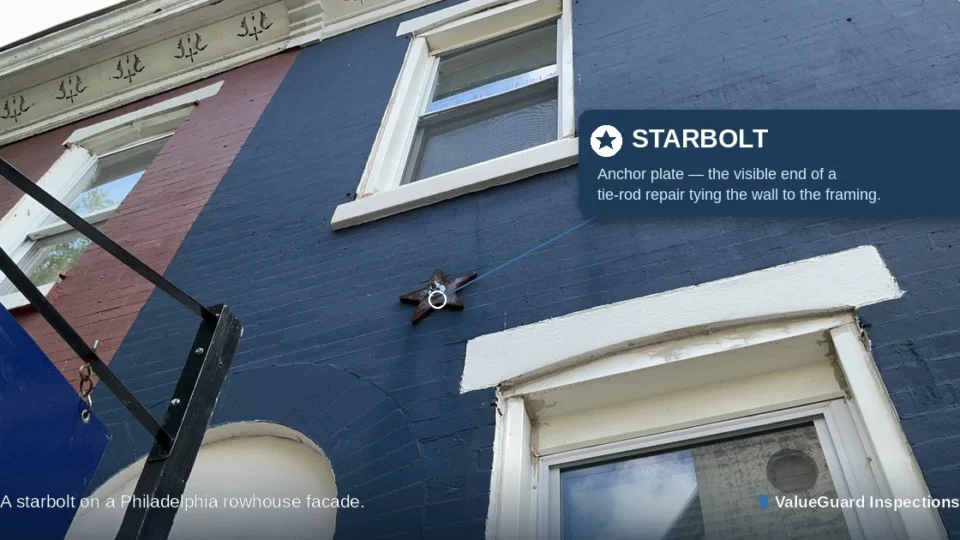
You’re walking a narrow, sun-washed street in Society Hill or Fishtown, looking up at brick facades that have stood for more than a century. Scattered across the masonry, you notice them: metal stars, circles, and diamonds bolted into the brick. They look like vintage folk art — a little dash of Philadelphia character. But those stars aren’t decoration. They’re a visible sign that, at some point in this home’s long life, a wall began to move — and someone stepped in to stop it.
At ValueGuard, we’ve spent more than 25 years inspecting the distinctive architecture of the Greater Philadelphia area. We know that to a home buyer, a starbolt can read like a warning. But once you understand what these anchors actually do, you’ll usually see them for what they are: evidence that a previous owner already recognized a structural issue and paid to address it. Here’s what they mean, and what your ValueGuard inspector looks for when we find them.
The short version
Starbolts (also called anchor plates or wall washers) are the visible ends of a steel tie-rod system that anchors a bulging brick wall back to a home’s interior framing. They’re a structural repair, not decoration — and a properly installed, well-documented starbolt is usually a reassuring sign, not a reason to walk away. What matters is the quality of the repair and whether the wall is still moving, which is exactly what a home inspection assesses.
Those stars aren’t decorative — they’re structural
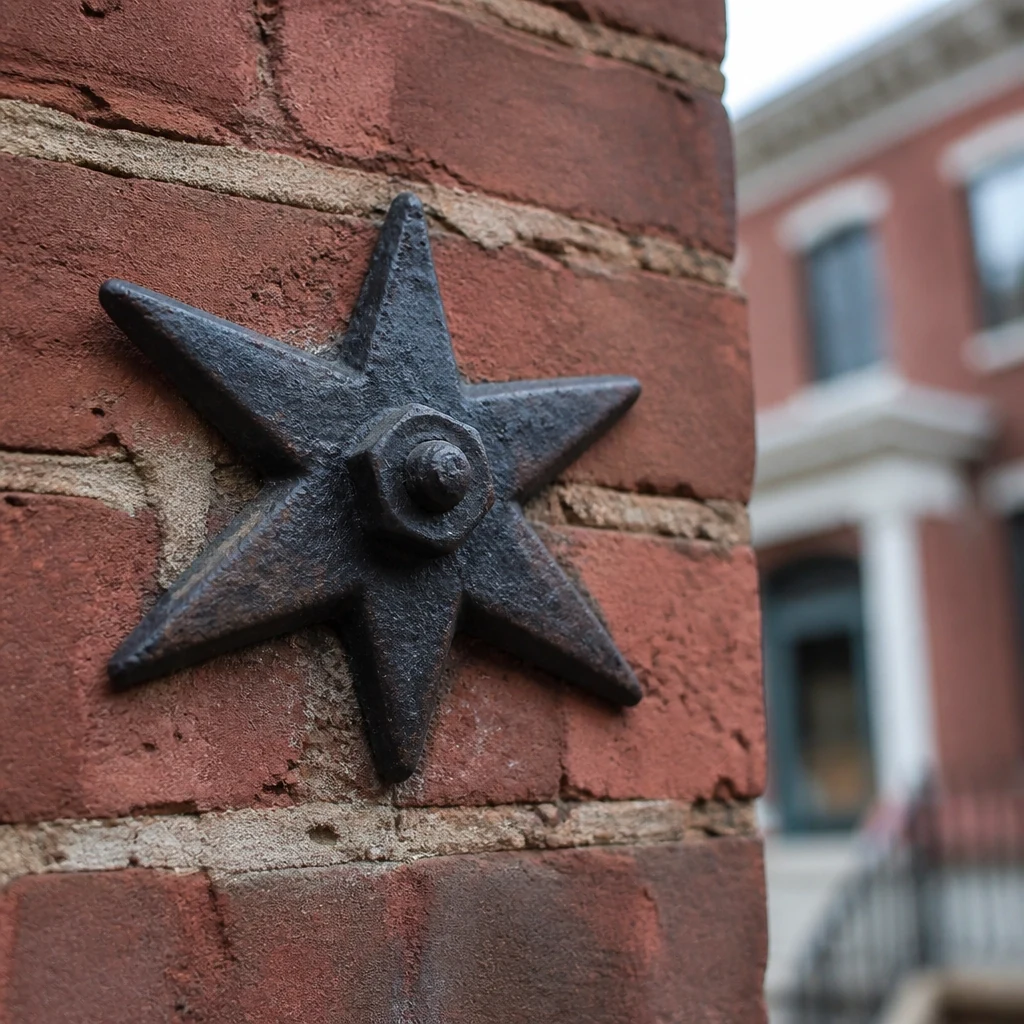
A starbolt (also called a star bolt, anchor plate, or wall washer) is the visible end of a mechanical tie-rod system. It’s a structural repair designed to stabilize a masonry wall that has begun to bulge, bow, or lean away from the rest of the house. Think of it as a giant industrial button holding a shirt closed where the fabric has started to pull apart.
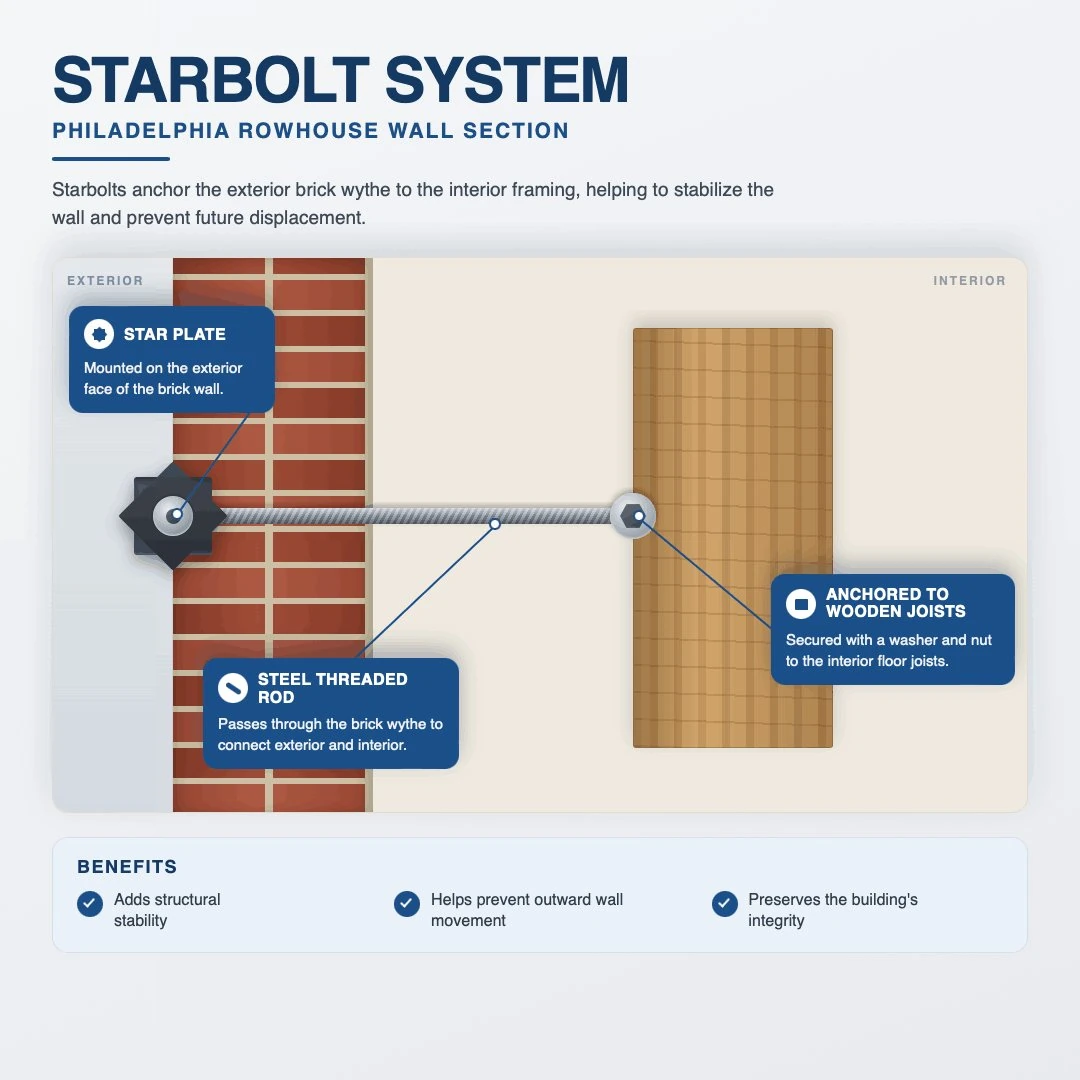
There are three parts to the system, and only one of them is visible from the sidewalk:
The threaded steel tie rod. This is the backbone — a long rod drilled through the exterior brick wall and run deep into the home’s interior.
The interior anchor. Inside the house, the rod is secured to the wooden floor joists or structural framing. This is where the real work happens: the repair borrows the strength of the home’s internal skeleton to hold the outside wall in place. In many installations, wood blocking is added between joists to help resist the pull.
The exterior plate. This is the star (or square, circle, or diamond) you see from the street. It acts as an oversized washer, spreading the load across many bricks so the rod doesn’t simply pull through a single point. The shape is mostly practical — a star happens to distribute pressure well — though it gives the city a lot of its character along the way.
Why Philadelphia rowhouses start to move
To understand why a home might need a starbolt, look at how these houses were built. Most Philadelphia rowhouses from the 19th and early 20th centuries are load-bearing brick with wood-framed floors and roofs. Critically, the floor joists usually run side to side — from one party wall to the next — parallel to the front and rear facades. That ties the side walls into the structure beautifully, but it leaves the front and back walls connected only at their edges.
A multi-story brick wall braced only at its edges has a natural tendency to bow outward over time. The original builders knew this, which is why good construction of the era already included iron anchors tying those facades back to the joists. The trouble is that iron encased in masonry doesn’t last forever. A hundred-plus years of wetting and drying corrodes those original anchors until they can no longer do their job. Add in deteriorating lime mortar, water penetration, foundation settling, and rot where joist ends sit in the masonry pockets, and a front or rear wall can slowly start to “belly out.”
None of this is unique to any one block — it’s a feature of the housing stock across the region, from Center City to the older neighborhoods of Montgomery, Bucks, Chester, and Delaware counties. The City of Philadelphia’s own Philadelphia Rowhouse Manual, a free homeowner’s guide published by the City Planning Commission, walks through exactly this kind of construction and the maintenance it needs. When the original ties give out, a modern starbolt system is the standard, time-tested way to re-anchor the wall.
So… is a starbolt a red flag?
This is the question we hear most: “If I see starbolts, should I walk away?” The answer is almost always no. In fact, a wall with starbolts is often a better sign than a bare wall that quietly needs them.
A wall with a two-inch bulge and no anchors is an active, unaddressed problem you’ll inherit and pay to fix. A wall with properly installed starbolts is a problem that has likely already been stabilized. What matters isn’t the presence of the stars — it’s the quality of the repair and whether the wall is still moving. That’s where a careful inspection earns its keep. Here’s what your ValueGuard inspector evaluates:
| What we evaluate | Reassuring sign | Possible concern |
|---|---|---|
| Cracks around the plate | Tight masonry, no fresh cracking, old paint intact over the joints | Fresh cracks radiating from the plate — a hint the wall is still moving |
| Plate placement | Aligned with the floor and joist lines, evenly spaced | Random or scattered placement, suggesting a DIY job rather than an engineered one |
| Mortar & pointing | Sound mortar; the wall was repointed when the work was done | Crumbling or open joints around the bolts |
| Wall profile | Bulge appears arrested; wall reads as stable | Continued bowing or a measurable lean |
| Interior signs | Level floors, sound plaster near the anchor points | Sloping floors, cracked plaster, or gaps where joists meet the wall |
| Documentation | Engineer’s report and city permits on file | No paperwork — the repair’s quality can’t be verified |
We translate this into plain language and, when needed, into negotiation leverage. If the starbolts were installed improperly or the wall still shows signs of active movement, that’s a real cost you’ll want to account for before closing — not after.
A proper installation is closer to minor surgery than to a weekend project. Here’s how a sound repair comes together:
1 The engineering assessment
A structural engineer evaluates how far the wall has moved and why, then specifies where the anchors go and how many are needed. This is the step that separates an engineered fix from a guess.
2 Opening up the interior
Reaching the joists usually means opening sections of ceiling or wall to find the strongest anchoring points. It’s invasive, which is part of why most of the cost is interior repair rather than the hardware itself.
3 Drilling and anchoring
Holes are drilled and the threaded rods are secured to multiple joists — not just one — so the load is spread across the framing rather than concentrated at a single point.
4 Tensioning the system
Finally, the exterior plates are tightened. Depending on the situation, this either gently draws the masonry back toward the structure or simply locks it in place so it can’t move another millimeter.
What do starbolts cost?
If you’ve found a home that needs stabilization — or you own one and want to maintain it — the numbers help put the decision in perspective. The hardware itself is cheap (often around $50 per assembly). The real expense is the specialized labor and the interior repairs after the walls are opened. These are general Greater Philadelphia ranges; every wall is different, so treat them as a starting point, not a quote.
| Repair approach | Typical cost (Greater Philadelphia) | When it’s used |
|---|---|---|
| A single installed starbolt | ~$500–$1,500 per anchor | A localized bulge that can be stabilized in place |
| A series of starbolts across a facade | Multiple anchors, priced per anchor | Broader bowing along an entire front or rear wall |
| Partial wall rebuild | Often several thousand dollars and up | Displacement too severe for anchors alone |
| Full facade reconstruction | Tens of thousands of dollars | A wall too far gone or unsafe to save |
Seen against a full reconstruction, starbolts are a remarkably efficient way to protect your equity. They preserve a home’s historic character while delivering the structural stability you need — which is exactly why a previous owner who chose them was usually making a smart, responsible call.
Don’t take a seller’s word that starbolts mean the wall is “fixed and done.” Ask for the structural engineer’s report and the City of Philadelphia permits, and have your inspector confirm there are no fresh cracks or interior signs of ongoing movement. Stars on the wall tell you a repair happened; they don’t tell you it was done right or that it held. That distinction can be worth thousands at the negotiating table.
Your starbolt must-ask toolkit
- When were they installed? Older repairs have had more time to prove they’re stable.
- Was a licensed structural engineer involved? This is a structural change, not a handyman special.
- Are there permits on file with the City? Permits mean the work was held to local safety standards.
- Are there interior signs of movement? Look for sloping floors or fresh plaster cracks near the anchors.
- What does my ValueGuard report say? We document the condition with 200–400+ photos and an actionable summary by the next business day.
Buying into a piece of Philadelphia history
Buying a home in a city this old means embracing the quirks of century-old construction. Those star-shaped plates are part of the heritage — proof that these houses were built to last and worth the effort to save. Our job at ValueGuard is to turn that hidden structural story into clear facts and a manageable plan, so you can buy a historic rowhouse with confidence instead of guesswork.
Whether you’re buying in Philadelphia itself, along the Main Line, or out in the surrounding suburbs of Montgomery, Bucks, Chester, and Delaware County, don’t let a metal star scare you away from the right home. Get the facts, get the inspection, and get the peace of mind you deserve. Ready for total clarity on your next home? Schedule your ValueGuard inspection today.
Frequently asked questions about starbolts
What are the metal stars on Philadelphia rowhouses?
They’re starbolts — the visible end plates of a tie-rod system that anchors a bulging brick wall back to the home’s interior floor joists. The star, square, diamond, or circle you see acts as a large washer that spreads the load across many bricks. They’re structural, not decorative.
Are starbolts a sign of a serious structural problem?
They’re a sign that a wall was moving and someone addressed it. Properly installed and inspected, starbolts indicate a stabilized wall — often a reassuring find. The concern is a wall that needs them but doesn’t have them, or anchors that were installed poorly.
Should I avoid buying a rowhouse with starbolts?
Usually not. A starbolted wall is generally better than a bare wall quietly developing the same problem. What matters is the quality of the repair and whether the wall is still moving — both of which a thorough home inspection can assess.
Why do so many Philadelphia rowhouses have them?
Rowhouse floor joists typically run side to side, leaving the front and rear brick walls braced only at their edges. Over a century, the original iron anchors corrode and mortar deteriorates, so those facades can bow outward. Starbolts re-anchor them — which is why they’re common across Philadelphia and the surrounding counties.
How much do starbolts cost to install?
In the Greater Philadelphia area, expect roughly $500 to $1,500 per installed anchor. The hardware is inexpensive — often around $50 per assembly — so most of the cost is the specialized labor and the interior repairs after walls are opened. It’s far cheaper than rebuilding a wall.
Do starbolts permanently fix the wall?
A properly engineered installation can stabilize a wall for the long term, but it isn’t “set and forget.” Fresh cracks around the plates, sloping floors, or new interior cracking can indicate the wall is still moving and needs another look. That’s exactly what an inspector watches for.
What does a home inspector check when a house has starbolts?
We look for fresh cracks radiating from the plates, whether the bolts align with the floor and joist lines, the condition of the surrounding mortar, the overall wall profile, and interior clues like sloping floors or cracked plaster. We also recommend asking the seller for the engineer’s report and permits.
Do starbolt repairs need permits or an engineer in Philadelphia?
Stabilizing a structural wall is a significant change and should involve a licensed structural engineer, with permits on file with the City of Philadelphia. Documentation is one of the clearest signs the work was done correctly — and its absence is a reason to dig deeper before closing.
Does ValueGuard inspect homes with starbolts across the Philadelphia suburbs?
Yes. ValueGuard inspects historic and modern homes throughout Philadelphia and the surrounding counties — Montgomery, Bucks, Chester, and Delaware — including rowhouses with starbolts and other masonry repairs, with a detailed, photo-rich report delivered by the next business day.

About ValueGuard Inspections. For more than 25 years, ValueGuard Inspections has helped home buyers understand the homes they’re about to buy across the Greater Philadelphia area — Philadelphia, Montgomery, Bucks, Chester, and Delaware counties. Every inspection includes 200–400+ photos and a clear, actionable report by the next business day.
Enjoying our home inspection guides? Get ValueGuard articles in your Google results: