
The Short Version
First-time home buyer anxiety is a response to uncertainty, not evidence that the house is bad. Buying your first home means taking on a mortgage, taxes, insurance and every system inside the building at once, usually on a short timeline in a competitive market. A professional home inspection cannot remove every risk, but it converts a vague fear into a sorted list: what is urgent, what is a safety issue, what is routine maintenance, and what is purely cosmetic. That sorted list is what turns a 2 a.m. worry into a decision you can actually make.
It is 2 a.m. The house is quiet. Your mind is not.
You are staring at the ceiling running mortgage math. What if you overpaid? What if the roof fails next winter? What if the basement floods, the sewer line collapses, or something catastrophic is hiding behind that fresh coat of paint?
If you are a first-time home buyer in the Greater Philadelphia area, that feeling is not a sign you are making the wrong decision. It is a sign you understand what is at stake.
Here is the part worth sitting with. You do not have to replace uncertainty with guesswork. You can replace it with information. That is exactly what a home inspection is for.
1The Anxiety Is About Uncertainty, Not the House
Buying your first home is probably the largest financial decision you have made. You are not only choosing a property. You are taking on a mortgage, taxes, insurance, utilities, maintenance, and responsibility for every system inside the building.
That is a lot to carry, and most first-time buyers we meet are carrying some version of the same seven worries: overpaying in a competitive market, buying a money pit, missing a serious structural or mechanical problem, losing the house by taking too long to investigate it, draining their savings the month after closing, trusting the wrong advice, and regretting the whole thing once the excitement wears off.
An inspection cannot eliminate every one of those risks, and no honest inspector should promise that it will. What it does is convert a vague fear — what if something is wrong? — into a sorted list of facts. Urgent. Soon. Routine. Cosmetic.
Knowing beats not knowing. Every time.
2A Fast Market Makes Information More Valuable, Not Less
Greater Philadelphia real estate moves quickly. You may be competing with several buyers. Your inspection window may be short. You may hear that a rival offer looks stronger because that buyer waived their inspection contingency.
That pressure can make asking questions feel dangerous. It is not.
Your Agreement of Sale defines your inspection rights and your deadlines, so review those terms with your real estate professional or attorney before you sign. Pennsylvania’s Home Inspection Law, Title 68 Chapter 75, governs how inspections are performed and what qualifications and duties inspectors carry.
The move is simple. Understand your timeline before you make an offer, then schedule your inspection the moment the agreement is signed. A fast market does not make information less valuable. It makes useful information more valuable, because you have less time to decide what to do with it.
And if the contingency is already gone, the information half is still available to you. That is the subject of our companion piece on the post-settlement home inspection.
3Information Overload Is Not the Same as Understanding
You probably have a dozen browser tabs open right now. Zillow says one thing. Reddit says another. An uncle warns you about old plumbing. A friend insists every Philadelphia rowhouse has foundation problems. Someone on a forum claims inspections exist mainly to scare buyers.
Now you are trying to decode the vocabulary.
Material defect. A significant problem that may affect the safety, function, value or use of the home. This is the category that carries real weight.
Deferred maintenance. Upkeep that has been postponed. Not an emergency, but almost always more expensive the longer it waits.
Further evaluation. The inspector found something that needs a qualified specialist to investigate. It is a flag, not a verdict.
End of useful life. A component still works, but it is aging and belongs in your replacement budget rather than your emergency fund.
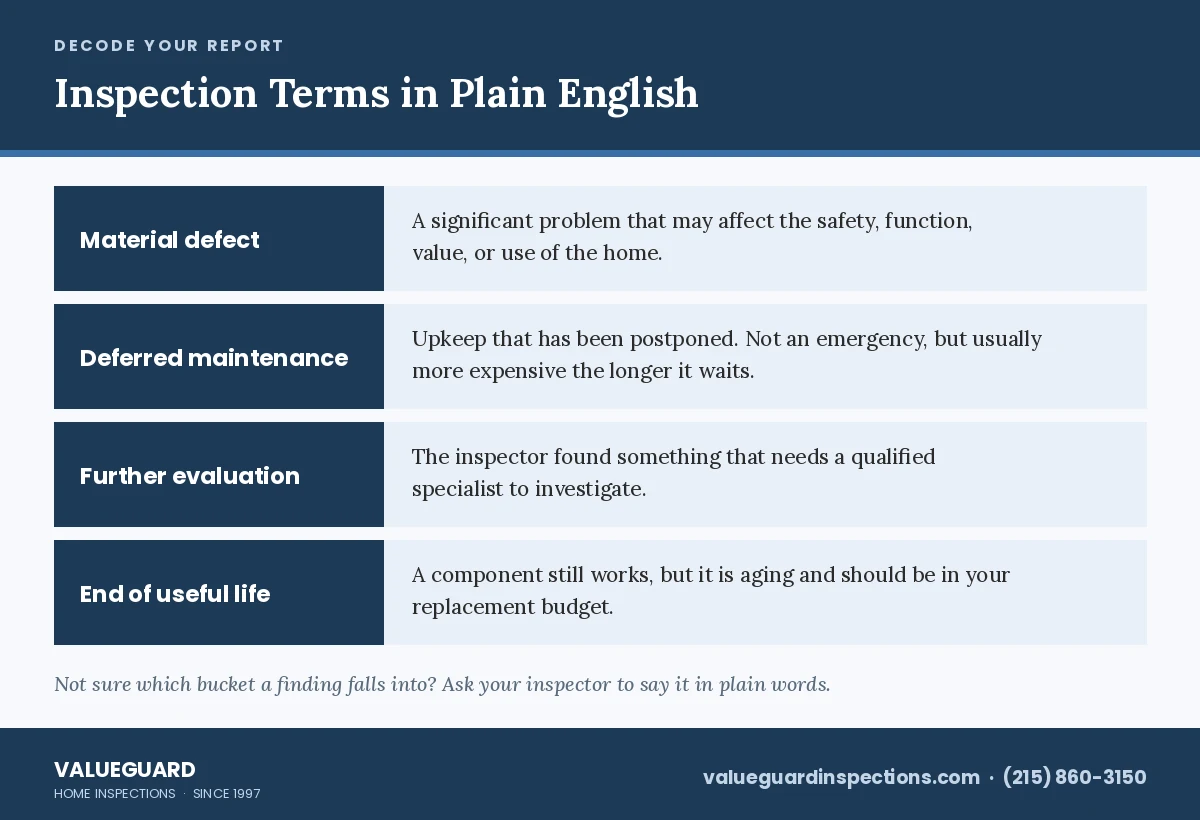
Plain language matters here, because the label alone does not tell you what to do. A cracked flue liner is not simply “a chimney issue.” It can mean combustion gases entering the living space, which is a safety concern and often real negotiating leverage. A moisture reading is not automatically mold. It is a clue pointing toward a leak, condensation, a drainage problem or poor ventilation.
Your job is not to become a structural engineer, electrician, plumber and HVAC technician overnight. Your job is to understand the home well enough to make a confident decision.
4Older Philadelphia Homes Deserve a Closer Look, Not Automatic Fear
Older homes have character. They also have history. A Philadelphia rowhouse, a century-old twin in Montgomery County, or an older Bucks County farmhouse may combine original masonry, aging utility lines and repairs made by five different owners across eighty years.
You might see bowing brick, star-shaped plates sometimes called starbolts, older wiring including possible knob-and-tube, cast-iron or clay sewer laterals, aging roofs and failing flashing, oil-fired heating equipment, basement moisture, or plumbing modifications that never appeared on the listing.
None of that automatically means run. That is the whole point of professional interpretation.
A starbolt may be part of an older wall-stabilization system rather than a crisis. Knob-and-tube wiring warrants further evaluation, especially where it has been modified or buried in insulation. A cast-iron sewer line may still function fine, but its age and condition deserve a camera.
Our guide to Philadelphia rowhouse inspection mistakes covers why local context matters so much. You need an inspector who can tell the difference between a characteristic of an old house, a maintenance item and a genuine defect. That distinction protects your budget and your peace of mind.
Worth Knowing
A long findings list is not a verdict on your house. Every occupied home produces findings, and reports run long because inspectors document maintenance items alongside material defects. The useful question is never how many lines the report contains. It is which two or three items affect safety or cost, and in what order.
5You Deserve an Inspector Who Works for You
When you hire ValueGuard, the inspection is performed with your interests in mind. You get buyer-focused, unbiased reporting rather than a contractor’s sales pitch or findings shaped to generate repair work for the inspector. ValueGuard does not inspect a home and then sell you the repairs, and that separation matters more than most first-time buyers realize.
Any report worth paying for should tell you seven things: what needs immediate attention, what affects safety, what gets expensive if you delay, what is routine maintenance, what a specialist should evaluate, what may give you negotiating leverage, and what can reasonably wait until after closing.
ValueGuard has been inspecting homes across Greater Philadelphia since 1997 — nearly three decades, more than 94,000 inspections, and over 200 years of combined inspection experience across the team. That experience is not just a number. It means your inspector has already seen how a small warning sign connects to a larger problem, and knows how to explain that connection without burying you.
A photo-rich report, usually the same day
When you are inside a short contingency period, waiting days for answers only compounds the stress. ValueGuard delivers a clear, photo-rich, actionable report by the next business day in nearly all cases, and most of the time the same day. You see what the inspector saw, where it was found, and why it matters.
Read it in this order: summary first, then the photographs, then the detailed explanations and limitations. Our guide on how to read a home inspection report will help you focus on the findings that matter instead of treating every line item as an emergency.
6Attend the Inspection, and Bring These Questions
Come to the inspection whenever you can. Walk with your inspector. Look at the attic, the basement, the electrical panel, the roof, the plumbing fixtures, the heating equipment and the exterior drainage.
You do not need technical knowledge before you arrive. You need curiosity. These seven questions will get you most of the way there.
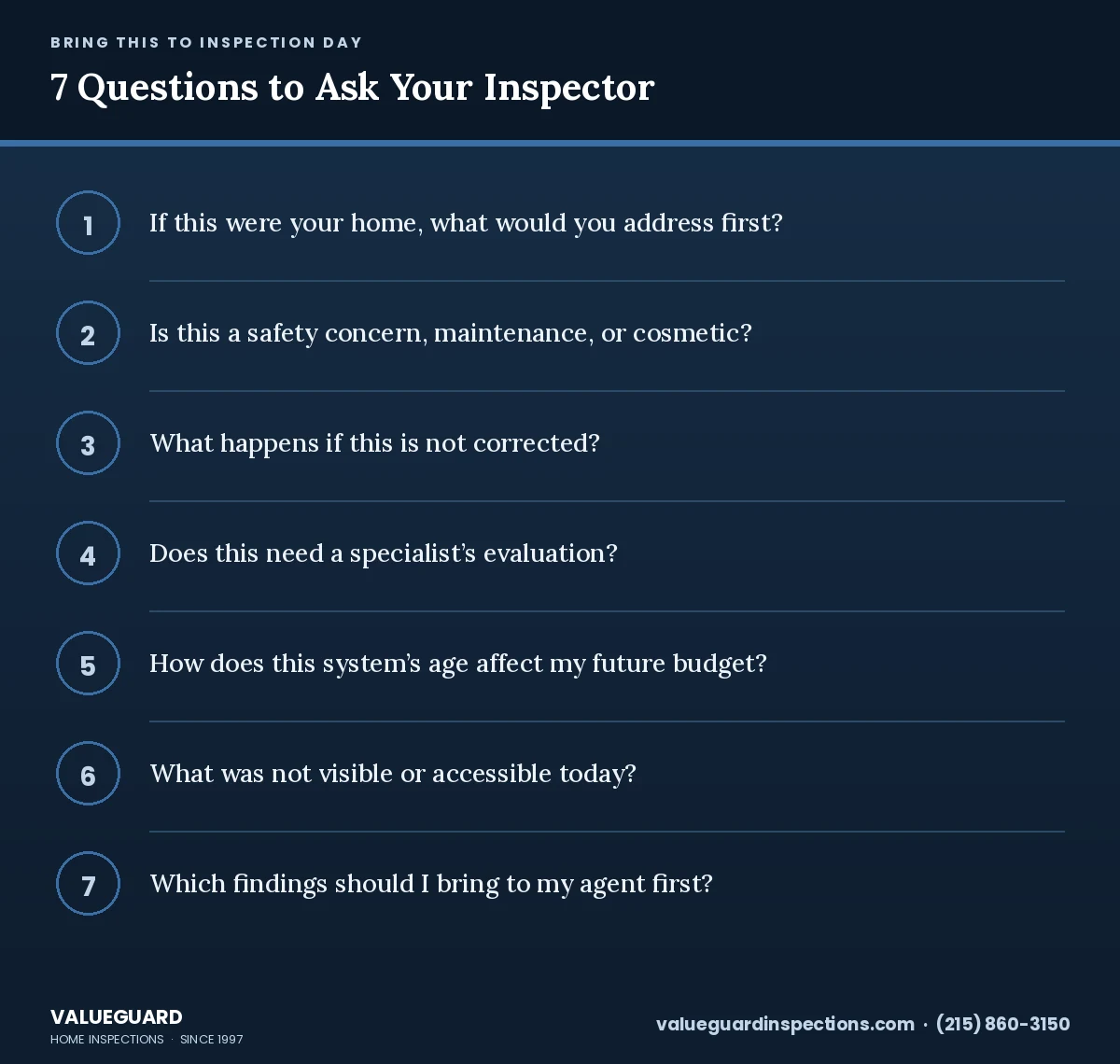
A good inspection is not a performance you watch from across the room. It is a conversation about a house you may soon own, and the person doing the talking should be able to answer in plain words.
7Targeted Add-Ons Remove the Biggest Unknowns
A standard home inspection is comprehensive, but some concerns need specialized tools and sit outside its scope. Depending on the property’s age, location and construction, these are the four worth asking about.
Worth Adding, and Why
Radon testing — measures an invisible, odorless radioactive gas that accumulates indoors and is common across southeastern Pennsylvania. Outside the scope of a general inspection. The EPA recommends action at 4.0 pCi/L or higher.
Sewer scope — sends a camera down the underground lateral to find breaks, root intrusion, deterioration and blockages. Strongly recommended on older homes with clay or cast-iron laterals.
MoistureGuard — combines moisture meters, thermal imaging and humidity readings to find hidden moisture in basements, attics, roofs and exterior walls. One in three ValueGuard clients adds it.
Termite and mold inspections — wood-destroying insect evidence and the conditions associated with fungal growth, evaluated when the property or your concerns warrant it.
Read more about why sewer inspections matter, or see how MoistureGuard works. The goal is never to frighten you. It is to give you a clearer picture before you commit.
8Your First-Time Buyer Checklist
Here is the whole thing in one place. It works whether you hire us or someone else, and it is short enough to keep on your phone.
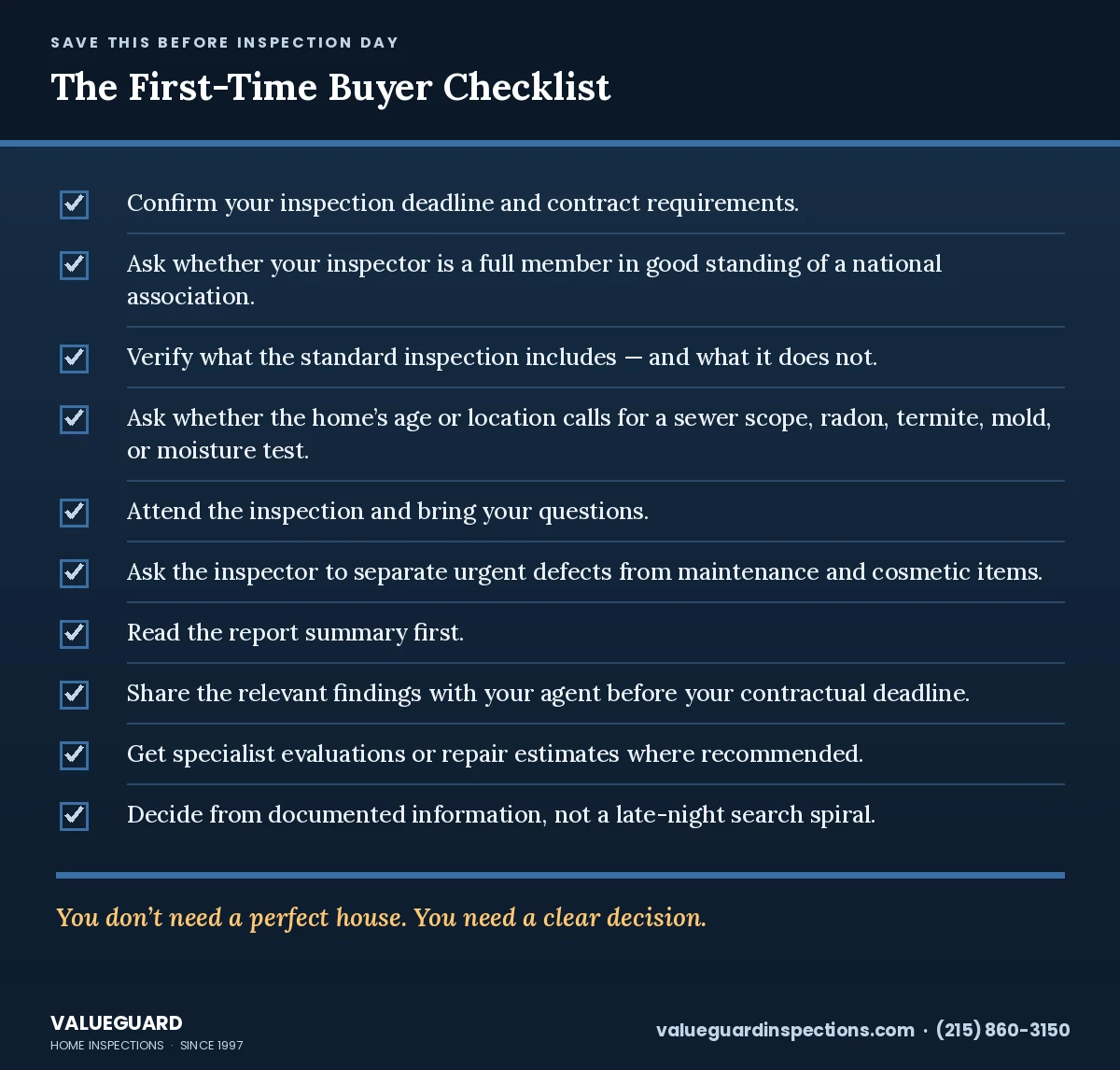
The last line on that list is the one that matters most. Decide from documented information, not from a late-night search spiral.
You Do Not Need a Perfect House. You Need a Clear Decision.
Every home has imperfections. A professional inspection does not promise a problem-free house. It gives you the information to decide whether the condition, the costs and the risks fit your goals.
Maybe the inspection confirms the house is sound. Maybe it surfaces repairs you can negotiate. Maybe it shows the home needs more work than you are prepared to take on. All three outcomes are wins, because all three are decisions made with your eyes open.
ValueGuard supports that decision with unbiased reporting, experienced local inspectors, next-business-day reports, targeted add-on services and a 100% satisfaction guarantee.
You are not buying an inspection to create more anxiety. You are investing in clarity — so your first home becomes a source of years of joy rather than a question mark hanging over every quiet night.
Know what you are buying before you sign.
Serving Philadelphia, Bucks, Chester, Delaware, Montgomery, Berks and Lancaster counties.
or call (215) 860-3150
Frequently Asked Questions
Is it normal to feel anxious about buying my first home?
Yes, and it is extremely common. Anxiety tracks uncertainty rather than danger. The most effective way to reduce it is to replace assumptions with documented facts about the home’s actual condition, which is what an inspection report gives you.
Should I waive the inspection contingency to win a competitive offer?
That is a decision for you, your agent and your attorney, and it carries real financial risk. Talk through the alternatives first. A shorter inspection window or an information-only inspection may keep your offer competitive without giving up your right to know what you are buying. If you have already waived and settled, a post-settlement inspection still gets you the information half.
How long does a home inspection take?
Most single-family inspections in the Philadelphia area run two to three hours, depending on the size, age and condition of the home. Add-on services such as a sewer scope or radon test can extend that. Larger or older properties often take longer.
Should I attend the home inspection?
Whenever possible, yes. Attending turns a written report into a conversation, and it is the fastest way to learn how your new home actually works. You do not need technical knowledge beforehand. Bring questions and follow your inspector through the attic, basement, panel and exterior.
When will I get my inspection report?
ValueGuard delivers photo-rich reports by the next business day in nearly all cases, and the majority go out the same day. That timing matters most when you are working inside a short contingency period and need to talk with your agent before a deadline.
Does an old Philadelphia rowhouse always have foundation problems?
No. Older masonry homes commonly show settlement, prior repairs and stabilization hardware such as starbolts. An experienced local inspector can tell you which of those are normal for the age and construction and which point to active movement that needs a structural engineer.
What does “further evaluation” mean in an inspection report?
It means the inspector found a condition that requires a qualified specialist to investigate more thoroughly. It is a flag, not a verdict. A general home inspection is visual and non-invasive by design, so certain findings are properly referred to a structural engineer, licensed electrician, plumber or HVAC contractor.
Which areas does ValueGuard serve?
We inspect throughout Greater Philadelphia, including Philadelphia, Montgomery County, Delaware County, Chester County and Bucks County, with particular depth on older homes across the Main Line.

About ValueGuard Inspections
ValueGuard Inspections has served Greater Philadelphia since 1997, inspecting homes throughout Philadelphia, Montgomery, Bucks, Chester and Delaware counties. Our ASHI-certified inspectors specialize in the region’s older housing stock, and every inspection produces a photo-rich, plain-English report you can act on.
Call (215) 860-3150, email Team@valueguardinspections.com, or find us on Google.
Enjoying our home inspection guides? Get ValueGuard articles in your Google results: