By Cory Shalaway, Director of Technical Services · Updated · Based on 1,999 ValueGuard inspection reports
Every home inspection report tells one house’s story. Put 1,999 of them side by side and a different story shows up: the same problems, in the same places, in house after house across Greater Philadelphia. We went through every full home inspection report our inspectors published between September 16, 2025 and September 15, 2026. Then we counted the most common home inspection problems, one finding at a time.
What we found should put buyers at ease. Most of the findings at the top of the list are small and cheap to fix. Some of them still matter a great deal for safety. Here is the list, what each finding means, and what to do about it.
The short version
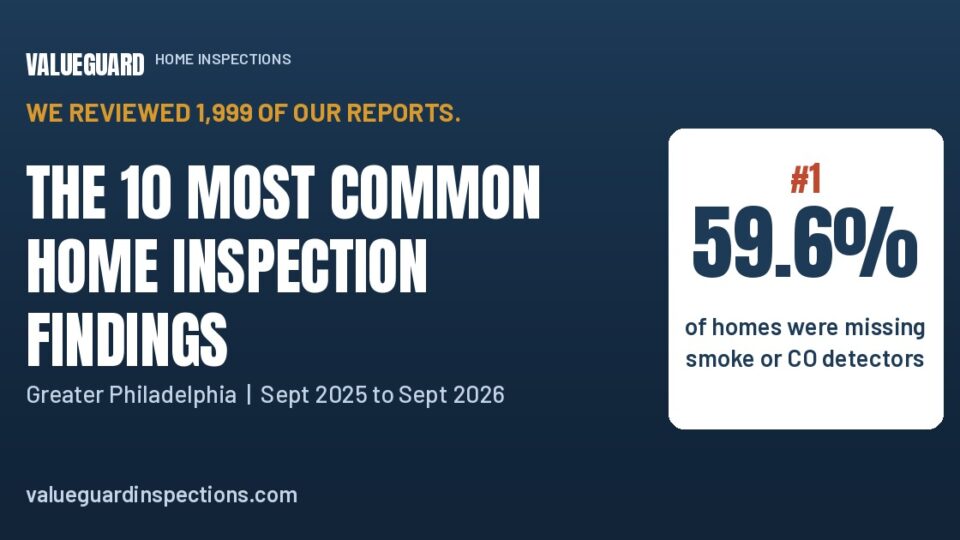
The most common home inspection problem in Greater Philadelphia is missing smoke or carbon monoxide detectors, found in 59.6% of homes. That’s according to ValueGuard’s review of 1,999 home inspection reports from September 2025 to September 2026. Next came missing GFCI outlet protection (42.7%), interior doors that stick or won’t latch (36.9%), missing range anti-tip brackets (32.6%) and missing stair handrails (32.2%).
The median report listed 50 findings. 78.6% of homes had at least one of four low-cost safety gaps: detectors, GFCI protection, an anti-tip bracket or a handrail.
In this article
|
1,999
home inspection reports reviewed
|
50
findings in the median report
|
95%
had at least one safety concern
|
1What are the most common home inspection problems?
The ten most common home inspection problems in Greater Philadelphia are all basic safety gaps, everyday wear or signs of water. Each bar shows the share of homes with that finding at least once. A home with three missing GFCI outlets counts once, not three times. Colors show how our reports usually classify each finding.
Share of homes with each finding
1,999 ValueGuard home inspection reports, Sept 2025 to Sept 2026
| 1. Smoke or CO detectors missing | 59.6% | |
| 2. GFCI protection missing | 42.7% | |
| 3. Interior doors stick or won’t latch | 36.9% | |
| 4. Range anti-tip bracket missing | 32.6% | |
| 5. Stair handrail missing | 32.2% | |
| 6. Light fixtures not working | 30.2% | |
| 7. Loose electrical outlets | 30.1% | |
| 8. Railing gaps wider than 4 inches | 26.9% | |
| 9. Basement moisture stains or efflorescence | 26.7% | |
| 10. Suspected mold or fungal growth | 26.4% |
Usually a safety concern Usually a repair item
Four more findings sit just outside the ten most common home inspection problems. We couldn’t confirm a bathroom fan vented outside in 25.8% of homes. Dry water stains showed up in 22.6%, heating or cooling equipment overdue for service in 22.3%, and loose handrails in 21.9%.
2The most common safety findings: detectors, GFCI outlets and anti-tip brackets
#1 Missing smoke or carbon monoxide detectors (59.6%)
This is the most common finding in our reports, and it isn’t close. In 29.4% of homes, our inspectors flagged missing carbon monoxide detectors on their own. In many others, both smoke and CO detectors were missing, or smoke detectors weren’t in every spot where one is recommended.
It matters. According to the National Fire Protection Association, working smoke alarms cut the risk of dying in a home fire in half. (Seeing an old, yellowed unit? Read why that smoke detector is yellow.) Pennsylvania’s Carbon Monoxide Alarm Standards Act requires sellers to disclose whether CO detectors are installed on the property disclosure statement. The City of Philadelphia goes further and requires owners of one- and two-family homes to install CO alarms.
What to do: Add detectors before you move in. Put smoke alarms inside each bedroom, outside sleeping areas and on every level. Put CO alarms outside sleeping areas and on every level, especially if the home has gas or oil heat, a fireplace or an attached garage.
#2 Missing GFCI protection (42.7%)
A GFCI (ground fault circuit interrupter) outlet shuts off power in a fraction of a second when current leaks to ground, such as through water or a person. Current electrical code calls for GFCI protection near water and in damp spaces: kitchens, bathrooms, laundry areas, garages, basements and outdoors. Many homes in our area were wired before those rules existed.
We found it inside the house in 41% of homes, most often in kitchens, bathrooms and laundry areas, and outside in about 9%. An older home isn’t breaking the rules just because it lacks GFCIs. Adding them is still one of the cheapest safety upgrades you can make.
#4 Missing range anti-tip bracket (32.6%)
An anti-tip bracket is a small metal piece that anchors a freestanding range to the wall or floor. Without it, the weight of a child standing on an open oven door can tip the whole range forward, along with any hot pots on top. The U.S. Consumer Product Safety Commission’s range tip-over safety alert reports 13 deaths from range tip-overs between 2000 and 2008, many of them children under 10.
Brackets are often left off when a range is replaced or pulled out for cleaning. We found the problem on gas ranges in 23% of homes and on electric ranges in about 10%.
Why this list is good news
Four of the five most common findings (detectors, GFCI outlets, anti-tip brackets and handrails) are inexpensive fixes. 78.6% of the homes we inspected had at least one of them. Many buyers handle these in their first weekend in the house, and they rarely need to be part of a negotiation.
3Stairs and railings: where falls happen
#5 Missing stair handrails (32.2%)
Missing handrails turn up most often on basement stairs and exterior steps. Modern residential code calls for a handrail on stairs with four or more risers. Older homes and do-it-yourself renovations often skip it. Loose handrails were a separate finding in another 21.9% of homes.
#8 Railing gaps wider than 4 inches (26.9%)
Today’s building code limits the openings in a guardrail so a 4-inch sphere can’t pass through, about the size of a small child’s head. Many older porch, deck and stair railings have wider spacing between balusters, or open gaps under the bottom rail. If young children will live in or visit the home, this finding deserves a closer look.
4Everyday wear: doors, lights and outlets
#3 Interior doors that stick or won’t latch (36.9%)
Houses move. Seasonal humidity swells wood, framing settles and hinge screws loosen. The result is a door that rubs the frame or won’t stay closed. It’s usually a quick fix with a screwdriver or a plane. When a lot of doors in the same part of the house bind, our inspectors also look for signs of structural movement nearby.
#6 Light fixtures not working (30.2%)
Often this is just a burned-out bulb. Inspectors don’t change bulbs, though, so we can’t rule out a bad switch, fixture or wiring problem. Ask the seller to replace the bulbs before your final walk-through and confirm every light works.
#7 Loose electrical outlets (30.1%)
An outlet that moves when you plug something in can strain the wire connections behind it. Over time, loose connections can heat up. Most loose outlets just need to be re-secured in the box, but that job belongs to a licensed electrician, not a butter knife.
5Water problems: basement moisture and suspected mold
#9 Basement moisture stains or efflorescence (26.7%)
Efflorescence is the white, chalky crust you see on basement walls. It’s left behind when water moves through masonry and then evaporates. It tells you water has been there, not whether it’s there today. The fix usually starts outside the house: gutters, downspout extensions and grading that slopes away from the foundation.
#10 Suspected mold or fungal growth (26.4%)
We note visible growth that looks like mold. Most of it turns up in basements, followed by crawlspaces and attics. A visual inspection can’t confirm what it is. That takes sampling and lab analysis. This finding rose through the year, from about one in five reports last fall to about one in three this summer, which is consistent with humid-season conditions.
If moisture is a concern, ask about MoistureGuard, our moisture analysis service. It’s included in select inspection packages and available as an add-on. We also offer mold inspections through our team of specialists.
6Do Philadelphia homes have different inspection problems than the suburbs?
Mostly no, but there are a few real differences. 1,190 of the reports were for homes in Philadelphia. The other 809 were elsewhere in our service area. The most common home inspection problems look almost the same in both, but a few findings split along city and suburban lines.
| Finding | Philadelphia | Suburbs |
|---|---|---|
| Basement moisture stains or efflorescence | 30.9% | 20.5% |
| Active knob and tube wiring | 14.4% | 10.5% |
| Range anti-tip bracket missing | 34.5% | 29.8% |
| Stair handrail missing | 34.4% | 28.9% |
| GFCI protection missing | 39.5% | 47.5% |
| Suspected mold or fungal growth | 23.9% | 30.0% |
| Smoke or CO detectors missing | 60.4% | 58.3% |
Philadelphia’s housing stock is older, with many masonry rowhomes built before modern waterproofing and wiring. That likely explains more basement moisture and more knob and tube wiring in the city. Suburban homes are more likely to have garages, crawlspaces and outdoor living areas, which are likely places for missing GFCI protection and fungal growth. See what we look for on our Philadelphia home inspections page.
7What are the biggest red flags in a home inspection?
The top 10 are common, but most are small. The biggest red flags in a home inspection came up less often. These are the findings that usually lead to repair requests, specialist evaluations or price negotiations:
Knob and tube wiring deserves a special mention. It was common in homes built before about 1940. Many insurers restrict or decline coverage while it’s still in use, so find out early in your contract period. Our local field guide to knob and tube wiring explains what to ask and what to budget for.
8What this means for buyers and sellers
A long report is not a bad house. The median report in our study listed 50 findings, and 95% flagged at least one safety concern. That’s what a thorough inspection looks like, not a warning sign. Knowing the most common home inspection problems ahead of time helps you read your own report calmly. What matters is sorting the handful of big items from the dozens of small ones.
Buyer’s first-weekend checklist
Sellers: Most of the top 10 can be fixed in an afternoon for little money. Taking care of them before listing removes easy line items from a buyer’s repair request. A pre-listing inspection shows you exactly where your home stands before buyers see it. See our inspection pricing for options.
We inspect homes across Philadelphia, Delaware County, Montgomery County, Chester County, Bucks County and the Main Line.
Know what’s on your list before you sign
Detailed, photo-rich reports, reviewed before delivery and usually ready the same day.
How we did it
We analyzed every published ValueGuard residential home inspection report for inspections dated September 16, 2025 through September 15, 2026: 1,999 reports in total. To identify the most common home inspection problems, we counted each report’s defect comments and grouped identical findings from different rooms into one. Each finding counts once per home. Termite, sewer scope, re-inspection and sample reports were excluded. These are homes our clients chose to inspect, mostly homes for sale, so the results describe that market rather than every house in the region. No client names or addresses were used.
Key statistics: home inspection findings in Greater Philadelphia (2025–2026)
Source: ValueGuard Home Inspections analysis of 1,999 residential home inspection reports, inspections dated September 16, 2025 to September 15, 2026. Journalists and bloggers are welcome to cite these figures with a link to this page.
Frequently asked questions
What is the most common problem found in a home inspection?
How many findings are normal in a home inspection report?
Does a seller have to fix missing smoke or CO detectors in Pennsylvania?
Is it a problem if my inspector found possible mold?
Are Philadelphia homes more likely to have inspection problems than suburban homes?
What are the biggest red flags in a home inspection?
What should I fix before selling my house in Philadelphia?

About ValueGuard Home Inspections
ValueGuard is a family-owned, ASHI-certified home inspection company that has served Greater Philadelphia since 1997, with more than 94,000 inspections completed. We inspect homes in Philadelphia, Bucks, Chester, Delaware, Montgomery, Berks and Lancaster Counties and New Castle County, Delaware. Every report is reviewed before delivery, and most are delivered the same day.
Find us on Google Maps | 100 E Penn Square, Suite 400, Philadelphia, PA 19107 | 215-860-3150
Enjoying our home inspection guides? Get ValueGuard articles in your Google results: