The Short Answer
Vermiculite insulation is a loose, pebble-like mineral insulation poured between attic joists in many homes built or insulated before about 1990. More than 70% of the vermiculite sold in the U.S. came from a Libby, Montana mine that was contaminated with asbestos, so the EPA says to assume any vermiculite insulation contains asbestos. Here’s what that means for you:
- Left alone, it’s generally low-risk. Asbestos harms you when fibers get into the air and you breathe them in.
- Don’t disturb it—no storage, no DIY removal, no vacuuming, and keep attic trips short.
- Any work that touches it—rewiring, HVAC, adding insulation, finishing the attic—should be planned with a certified asbestos professional.
- Removal may be partly reimbursable through the Zonolite Attic Insulation Trust if the material is proven to be Zonolite brand.
- For buyers, it’s a due-diligence and negotiation item, not an automatic deal-breaker.
Below: what our inspector found in a century-old Glen Mills home this September, how to recognize vermiculite, and exactly what to do next.
The attic in this Glen Mills home looked like a bonus. A full-size door, a proper staircase, and a wide plank floor running the length of the house—the kind of space a buyer immediately pictures as storage, a playroom, or a future office.
Then I looked down.
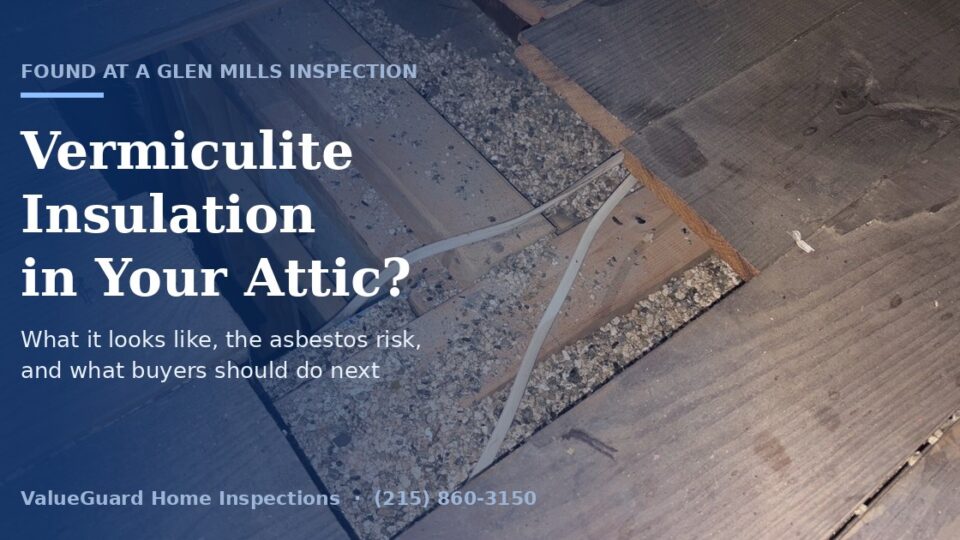
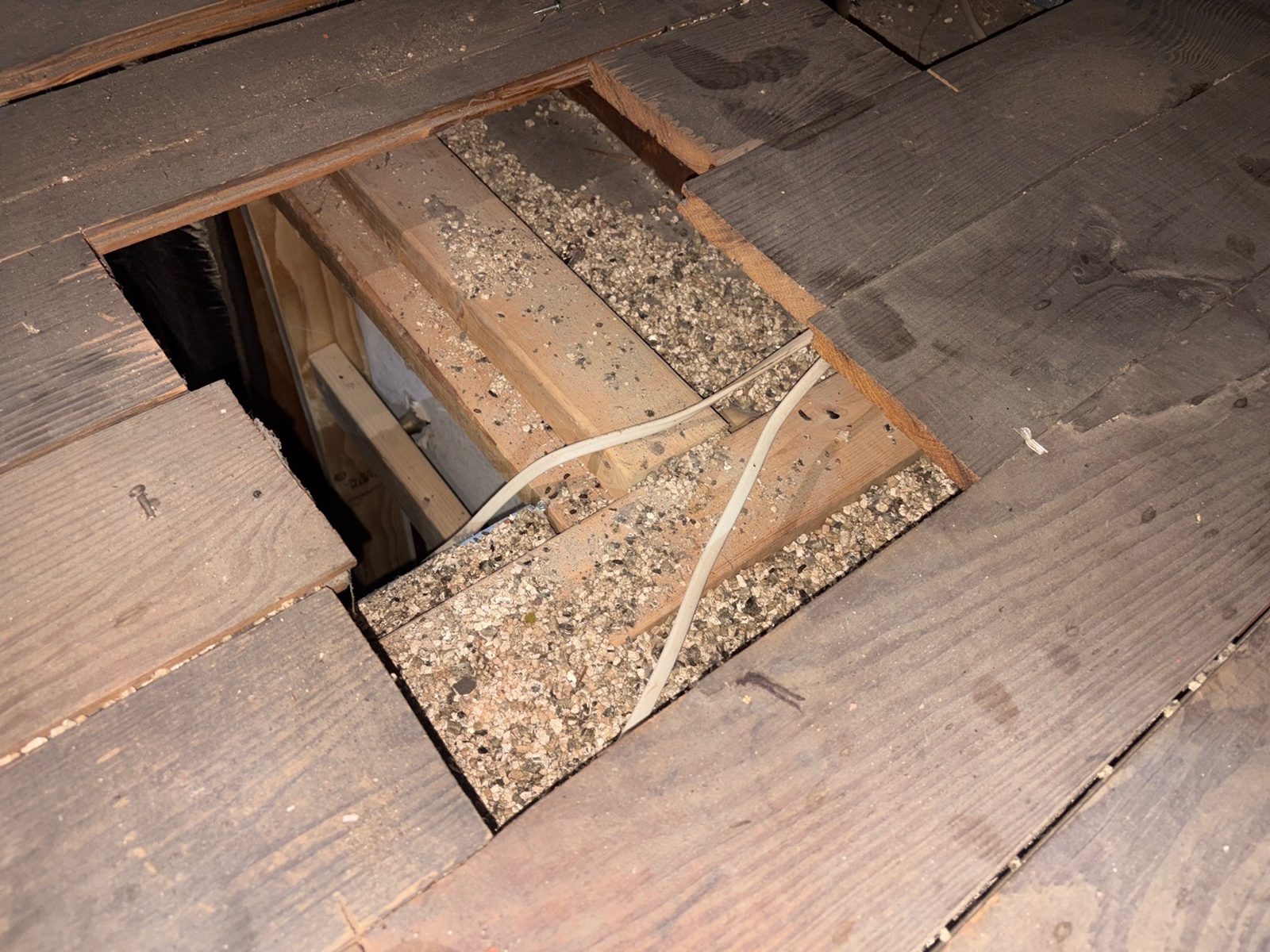
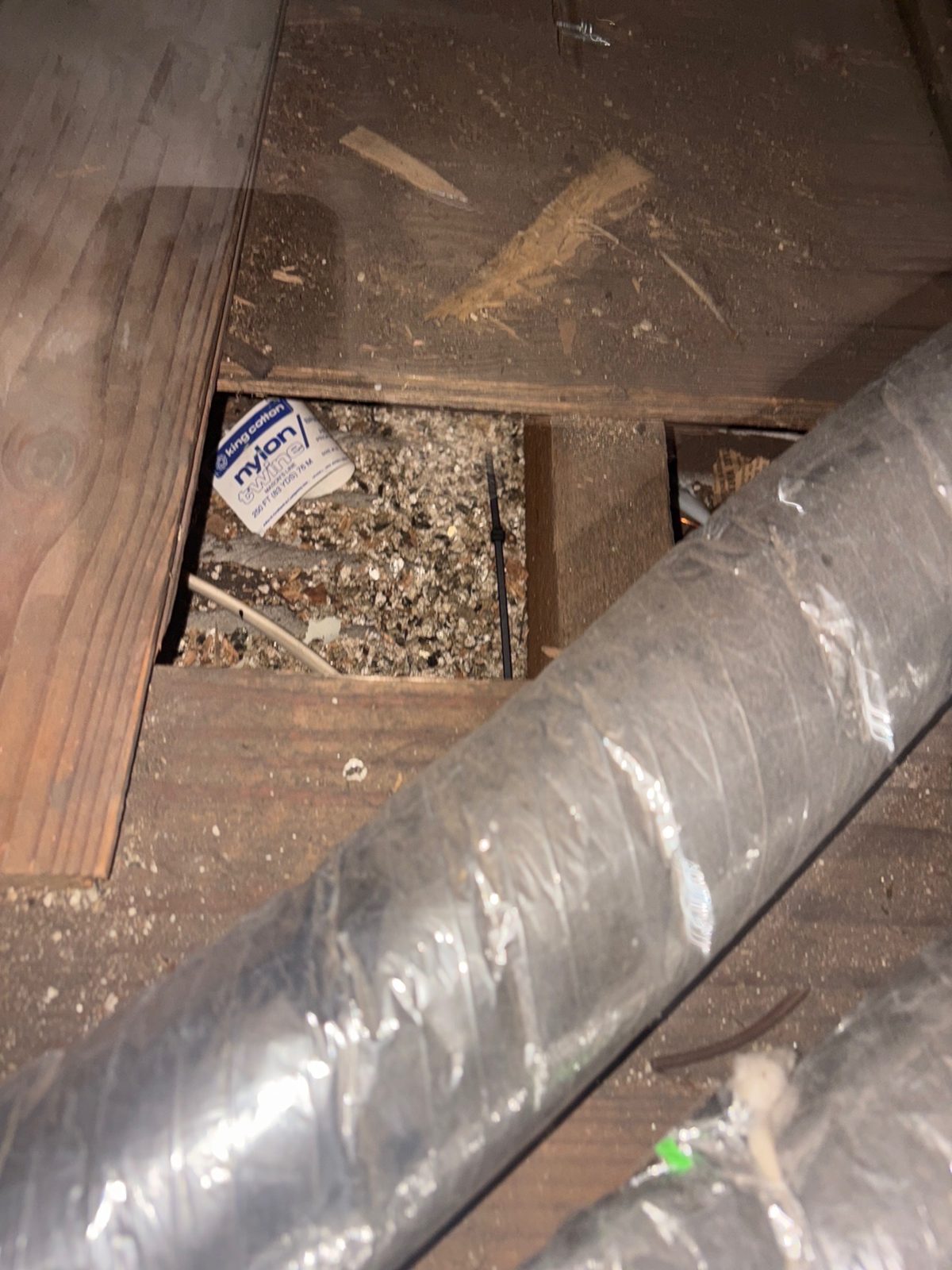
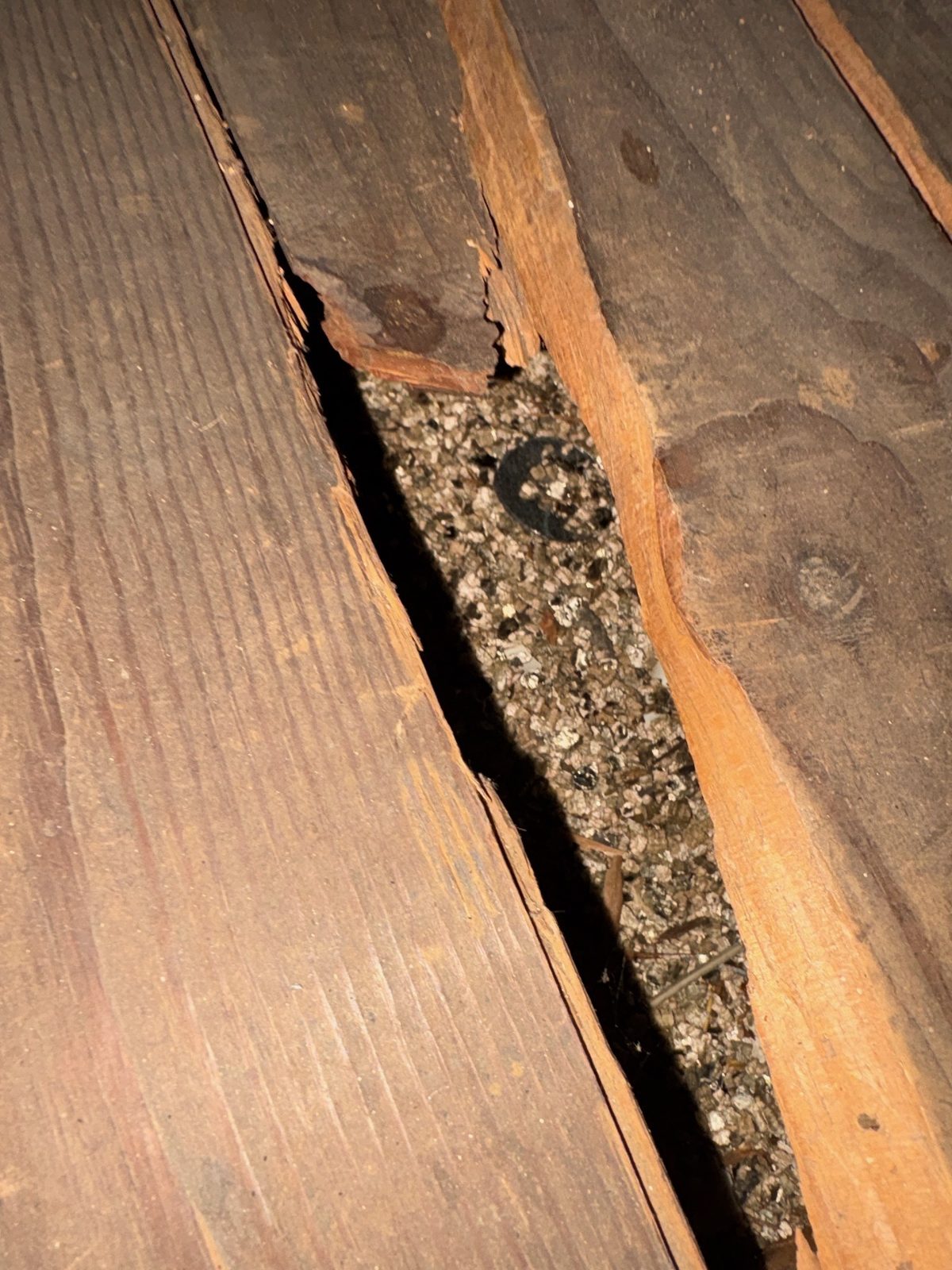
Through a hole in the floorboards, and through the gaps where the old planks had split and pulled apart, I could see what was sitting underneath: a layer of small, shiny, gold-and-gray granules filling the joist bays. Electrical cable ran right through it. A flexible HVAC duct lay across the floor above it. Tucked beneath the boards was a mix of old construction debris—including a spool box of nylon mason’s twine that had been sitting there for who knows how long.
That granular material was almost certainly vermiculite insulation. In a house built around 1915, it’s not a surprise—but it is one of the findings I take the most time to explain, because what a buyer does next matters far more than the fact that it’s there.
What Is Vermiculite Insulation?
Vermiculite is a naturally occurring mineral that puffs up like popcorn when it’s heated. The expanded granules are lightweight, fire-resistant, and good at trapping air, which made them a popular loose-fill insulation for most of the 20th century. Contractors—and a lot of do-it-yourself homeowners—simply poured it out of bags between the attic joists, and occasionally into wall cavities.
The problem isn’t vermiculite itself. According to the U.S. Environmental Protection Agency, more than 70% of all vermiculite sold in the United States from 1919 to 1990 came from a single mine near Libby, Montana—and that mine also contained a deposit of asbestos. The ore was contaminated, and much of it was sold as attic insulation under the brand name Zonolite.
Because there’s no way to tell by looking whether a particular attic’s vermiculite came from Libby, the EPA’s guidance is simple: treat all vermiculite insulation as if it contains asbestos.
What Does Vermiculite Insulation Look Like?
Once you’ve seen it, it’s hard to mistake for anything else. Here’s how to recognize it—ideally from the attic hatch or doorway, with a flashlight, without stepping into it:
Two things make it easy to miss. First, newer fiberglass or cellulose is often blown right over the top, so the older vermiculite layer only shows at the edges, around the hatch, or where the newer insulation is thin. Second—as in this Glen Mills home—it can hide completely under an attic floor. If the planks are tight and intact, you may never see it. Here, it only showed through damaged boards and gaps.
Also look for leftover bags. An empty sack labeled Zonolite or W.R. Grace is a strong sign the material came from Libby, and it’s valuable evidence if you ever file a reimbursement claim (more on that below). There was no bag in this attic, which is typical—most were thrown away decades ago.
|
|
Is Vermiculite Insulation Dangerous?
It can be—but the danger depends almost entirely on whether it’s disturbed.
Asbestos fibers cause harm when they become airborne and are inhaled. Long-term exposure is linked to asbestosis, lung cancer, and mesothelioma, and these diseases can take decades to appear. The EPA is blunt about it: there is no known safe level of asbestos exposure.
That said, vermiculite sitting undisturbed in a closed attic, or sealed inside a wall, generally presents a low risk to the people living below. The risk climbs when someone walks through it, stores boxes on top of it, sweeps or vacuums it, cuts into it during a renovation, or tries to bag it up themselves.
That’s what made this particular attic worth slowing down for. A walk-up attic with a floor invites use. And the floor itself was damaged—holes and loose boards—which means foot traffic can push granules around and dust can move through the gaps. The inspection also found low insulation levels, HVAC ductwork running through the space, and wiring buried in the vermiculite. Every one of those points toward future work in the attic. Every one of them has to be planned around this material.
What the EPA Says to Do
The EPA’s core recommendations for homeowners with vermiculite insulation are straightforward:
- Leave it undisturbed. Don’t open walls just to check for vermiculite.
- Don’t store items in the attic, and don’t let children play there.
- Limit trips into the attic and keep them as short as possible.
- Never try to remove it yourself.
- Hire trained, certified asbestos professionals before any remodeling or repair that could disturb it.
One more practical step worth asking a professional about: gaps in the ceiling below the attic—around light fixtures, ceiling fans, and the attic hatch or door—can let loose material sift into living space. Sealing those pathways is often part of a sensible “leave it in place” plan.
Should You Test Vermiculite for Asbestos?
This surprises a lot of buyers: the EPA does not recommend routine testing for homeowners. Asbestos can be distributed unevenly through vermiculite, so a few samples may come back clean even when other parts of the attic aren’t. A negative lab result doesn’t prove the whole attic is safe, which is why the practical standard is to assume contamination and act accordingly.
There are two situations where testing does make sense:
- You need documentation—for a lender, an insurer, a renovation permit, or a negotiation. If you test, use an accredited lab and ask about methods suited to vermiculite, such as transmission electron microscopy (TEM).
- You plan to file a Zonolite Trust claim. The Trust requires proof that the material is Zonolite brand, and it asks claimants to collect samples before removal. Once it’s gone, you can’t go back and sample it.
Either way, sampling should be done by a trained asbestos professional, not by poking around in the attic yourself.
Does a Home Inspection Test for Asbestos?
No. A standard home inspection is a visual, non-invasive evaluation, and the ASHI Standards of Practice—the standards ValueGuard inspects to—exclude determining the presence of asbestos and other environmental contaminants. (We cover the full list in what a home inspection doesn’t cover.)
What a good inspector will do is recognize suspect material, photograph it, and tell you plainly what it means. In this case, the report entry read, in part:
“What appears to be vermiculite insulation observed. The majority of vermiculite insulation in the United States came from a mine contaminated with asbestos. It should be assumed that this material is contaminated with asbestos. The material should not be disturbed and if removal is necessary, the U.S. Environmental Protection Agency (EPA) always recommends contacting a professional for any abatement project.”
Notice the wording: what appears to be. We don’t sample, and we don’t walk around in it. We identify it, flag it, and point you to the right specialist. That’s also why we note it’s possible other asbestos-containing materials exist in an older home beyond what’s visible—pipe wrap, old floor tile, and some siding and plaster products, among others. If you want help decoding the rest of your report, see our guide to how to read a home inspection report.
Removal, Encapsulation, or Leave It Alone?
You have three realistic paths, and the right one depends on how you’ll use the house.
1. Leave it in place. If the attic will stay closed, unused, and untouched, leaving the vermiculite alone is often the most practical choice—and it’s consistent with EPA guidance. The catch is that “untouched” has to be true. Plan for the day an electrician, HVAC technician, or insulation contractor needs to get up there.
2. Isolate or encapsulate it. In some attics, an asbestos professional may recommend sealing the ceiling below, isolating the area, or covering the material to keep it contained. This doesn’t eliminate it, but it can reduce the chance of disturbance.
3. Professional removal. If you plan to finish the attic, add insulation, run new ductwork, or rewire—especially in an older home where the wiring may already need attention (this property’s detached garage had inactive knob-and-tube wiring)—removal is usually the cleanest long-term answer. In Pennsylvania, anyone doing asbestos removal must work for a contractor certified by the Department of Labor & Industry. Expect containment, negative air pressure, specialized vacuum equipment, and proper disposal.
What does removal cost? It varies widely with attic size, access, and how much material is present. National cost guides such as Angi put asbestos attic-insulation removal at roughly $11 to $25 per square foot, plus the cost of new insulation afterward. Get at least two written quotes from certified abatement contractors before you decide—and ideally before your inspection contingency expires.
Can You Get Reimbursed? The Zonolite Attic Insulation Trust
If your vermiculite turns out to be Zonolite, you may be able to recover part of the removal cost. The Zonolite Attic Insulation (ZAI) Trust was created through the W.R. Grace bankruptcy to partially reimburse property owners for removing Zonolite and re-insulating.
According to the Trust’s current FAQs:
- Eligible claims currently receive 55% of the Trust’s approved cost for removal and reasonable re-insulation.
- There’s a cap. For the Trust’s 2026 fiscal year, the maximum approved cost is $9,813.61, which means the most a claim can currently receive is about $5,397.
- Payouts are expected to go down. The Trust has finite funds and warns that the percentage may decrease, with little notice, due to claim volume.
- You must prove it’s Zonolite. The Trust estimates about 75% of vermiculite in homes is Zonolite brand; the other 25% doesn’t qualify. Proof can include bags, other identification evidence, or Trust-tested samples.
- Collect samples before removal, following the Trust’s sampling instructions, and keep paid invoices and before-and-after photos.
Rules and amounts change, so always go straight to the Trust’s official site at zaitrust.com rather than relying on a contractor’s summary or a third-party website.
Buying or Selling a Home with Vermiculite
For buyers: Vermiculite isn’t necessarily a reason to walk away. It’s a reason to do your homework during your inspection contingency. Get abatement quotes if you plan any attic work, factor the cost into your negotiation, and think honestly about how you’ll use the space. A buyer who never goes into the attic is in a very different position than one who plans to finish it or upgrade the insulation.
For sellers: Federal law doesn’t require sellers to disclose asbestos. Pennsylvania’s Real Estate Seller Disclosure Law is different: the state’s Seller’s Property Disclosure Statement includes a hazardous-substances section that asks about asbestos, and sellers are expected to disclose material defects they know about. If a prior inspection flagged vermiculite, it’s known. If you’re listing an older home, a pre-listing inspection lets you find issues like this on your own timeline instead of in the middle of a buyer’s negotiation. For questions about your specific disclosure obligations, talk with your agent or a real estate attorney.
For both: Avoid conflicts of interest. The EPA advises that the professional who assesses or samples asbestos-containing material generally shouldn’t be the same company you pay to remove it. (ValueGuard never bids on or performs repairs, so our findings are never a sales pitch.)
Found Vermiculite? Your 7-Step Checklist
| 1 | Don’t disturb it. Stay out of the attic except when necessary, and don’t store anything up there. |
| 2 | Photograph it from the hatch or doorway—plus any bags or labels you can see. |
| 3 | Decide how you’ll use the attic. Storage, finishing, new insulation, or HVAC and electrical work all change the plan. |
| 4 | Get quotes from PA-certified asbestos abatement contractors while your contingency is still open. |
| 5 | Tell every contractor who might work in the attic—electricians, HVAC techs, insulation installers, solar installers—before they go up. |
| 6 | If removing it, check ZAI Trust eligibility first and collect product-ID samples before removal begins. |
| 7 | Never DIY it. Not with a shop vac, not with a shovel, not “just a little bit.” |
Frequently Asked Questions About Vermiculite Insulation
The Bottom Line
A century-old house in Glen Mills can have beautiful bones and a wonderful attic—and still be hiding a layer of history under the floorboards. Vermiculite isn’t a reason to panic. It’s a reason to slow down, plan, and make decisions with clear information before you own the house, not after.
That’s what a thorough inspection is for. The attic is one of the most overlooked spaces in a home (we wrote about why in the hidden dangers of overlooking the attic), and it’s often where the most important findings are.
Get the Clarity You Deserve
Buying or maintaining a home should feel like a step forward, not a gamble. When you choose ValueGuard, you’re not just getting a checklist—you’re getting a photo-rich, plain-English roadmap of your home’s systems, delivered by the next business day. Our mission is radical transparency: the clear, honest information you need to protect your family and negotiate with confidence.
Ready for peace of mind? Schedule your inspection with ValueGuard today.

ABOUT VALUEGUARD INSPECTIONS
ValueGuard Inspections provides home inspections, sewer scopes, radon testing, and moisture evaluations across Philadelphia, Montgomery, Bucks, Chester, and Delaware counties. Rated 4.9★ by homebuyers — read our reviews on Google. Ready for peace of mind? Schedule your inspection at valueguardinspections.com or call (215) 860-3150.
Enjoying our home inspection guides? Get ValueGuard articles in your Google results: